
Sinusitis that returns every winter despite antibiotics, the ear infection that recurs in children without apparent reason, the cystitis that reappears a few weeks after treatment, or that dental plaque that keeps reforming. These infections that refuse to go away form a recognizable pattern. Antibiotics work for a few days, symptoms ease, then everything starts again.
When this cycle repeats several times a year, something other than the bacteria themselves is at play. Bacteria do not always live in isolation, floating freely in bodily fluids. They know how to build organized communities, enveloped in a matrix they secrete. This structure is called a biofilm.
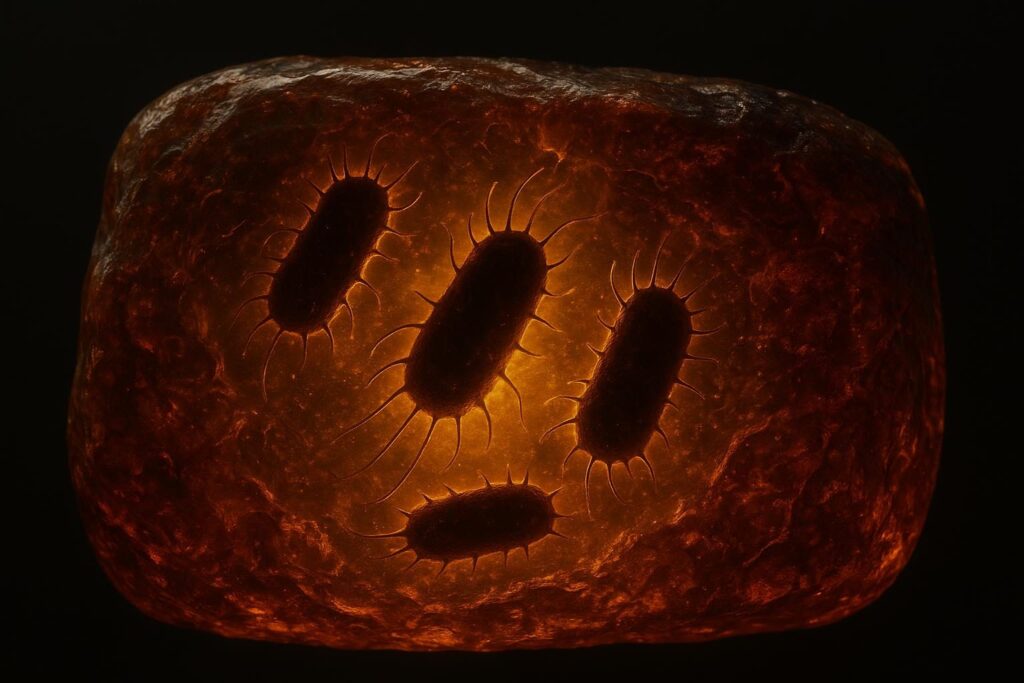
Like forms frozen in amber, bacteria protect themselves by encasing themselves in a dense, translucent layer that neither the immune system nor antibiotics can easily penetrate. Biofilms are involved in the majority of chronic and recurrent infections. Understanding this matrix, what it does, and how it maintains itself changes how we understand these infections that keep recurring.
Biofilm: A Collective Architecture
A biofilm is a structured, organized community capable of communicating and coordinating its defenses. The bacteria that compose it secrete an extracellular polymeric matrix, often called EPS for extracellular polymeric substances. This matrix is made of polysaccharides, proteins, extracellular DNA, and lipids. It forms a dense gel that envelops bacterial cells and holds them together.
Inside this gel, bacteria change their behavior. They slow down their metabolism, enter a state of partial dormancy, and become up to a thousand times more resistant to antibiotics than their planktonic counterparts, those that float freely. The matrix acts as a physical shield that limits the penetration of antibiotic molecules, dilutes their concentration, and provides a stable environment where bacteria can survive even under pressure.
Biofilms form wherever conditions allow. On catheters, medical implants, artificial heart valves, but also on the body’s natural mucous membranes: the mouth, sinuses, ears, bladder, lungs, intestines. Wherever a surface exists and a disturbed terrain offers favorable conditions, a biofilm can settle.
The Unmistakable Signal: Recurrence
The most telling clinical sign of a biofilm infection is recurrence. Antibiotics work for a few days, symptoms disappear, then everything starts again when treatment stops. This pattern repeats several times a year, sometimes several times a month.
When antibiotics are introduced, they kill the planktonic bacteria, those circulating freely in bodily fluids. But those enveloped in the matrix remain protected. They wait.
Once the treatment is over, they reactivate, detach from the biofilm, recolonize the environment, and symptoms return. This cycle can last for years if the terrain remains favorable and the matrix is never targeted.
The Mouth: The Everyday Biofilm
Dental plaque is the most universal biofilm. It forms on teeth a few hours after brushing, a translucent and sticky film composed of hundreds of bacterial species organized in successive layers. If not removed mechanically, it mineralizes and becomes tartar, an even more difficult structure to eliminate.
This oral biofilm maintains chronic inflammation of the gums, called gingivitis, which can progress to periodontitis when underlying conditions allow it. Periodontitis is associated with low-grade systemic inflammation that circulates throughout the body.
The link between periodontitis and diabetes is one of the best-documented relationships. People with diabetes are about three times more likely to develop periodontitis. But the relationship is bidirectional.
Periodontal inflammation impairs glycemic control and worsens insulin resistance. The disturbed metabolic terrain favors the biofilm, and the biofilm, in turn, worsens the disturbance.
The oral biofilm is primarily dislodged mechanically. Brushing, flossing, professional cleaning at the dentist. But as long as the terrain remains inflammatory, as long as the total chronic carbohydrate load remains high, whether from bread, pasta, rice, fruits, or juices, the biofilm reforms quickly. The terrain matters as much as mechanical hygiene.
The Sinuses: A Humid and Closed Shelter
Chronic sinusitis affects millions of people. It manifests as persistent congestion, facial pain, loss of smell, post-nasal drip that never really goes away. Antibiotics work for a few days, then everything starts again.
Studies of sinus tissue collected during surgery revealed the presence of biofilms in 80% of patients with chronic sinusitis, compared to 0% in control subjects. These biofilms are composed of several bacterial species, often Staphylococcus aureus, Pseudomonas aeruginosa, or Haemophilus influenzae, organized in dense and resistant communities.
Mechanical treatment, through nasal irrigation or surgical debridement, can help remove part of the biofilm. But as long as the terrain remains inflammatory, as long as the mucosae remain congested and local immunity remains weakened, the biofilm reforms. Chronic inflammation, pro-inflammatory diet, chronic stress, all create favorable conditions for the persistence of the biofilm.
The Ears: A Hidden Reservoir in Children
Recurrent ear infections in children are another classic example. The infection seems to resolve with antibiotics, then returns a few weeks later. This cycle can repeat several times a year for years.
A study published in JAMA in 2006 revealed the presence of biofilms in 92% of middle-ear mucosal samples from children with recurrent ear infections, while bacterial cultures were often negative. These biofilms act as a protected reservoir. Bacteria survive there between infectious episodes, then reactivate as soon as conditions allow.
Recognizing this signal, recurrence despite treatment, points toward complementary approaches that target the terrain and mucosal immunity, not just the isolated bacteria.
The Respiratory Tract: Bronchitis and Mucus
Chronic bronchitis and some recurrent lung infections are also associated with biofilms. Bacteria envelop themselves in thickened mucus, forming aggregates that are difficult for the immune system and antibiotics to reach. Pseudomonas aeruginosa is particularly known for forming biofilms in the lungs, especially in people with cystic fibrosis.
Mucus, when it becomes too thick and stagnant, offers a favorable environment for biofilm formation. The disulfide bridges that maintain this excessive viscosity are part of the protective matrix. This is where NAC, or N-acetylcysteine, comes into play.
By breaking these bridges, NAC thins the mucus and weakens the biofilm matrix. In vitro studies show it can completely dissolve Pseudomonas aeruginosa biofilms at concentrations of 10 mg/ml. Clinical data remain limited, but the mechanistic logic is solid.
The Bladder and Recurrent Urinary Infections
Recurrent urinary infections mainly affect women. They manifest as burning, frequent urges to urinate, and sometimes fever. The symptoms seem to resolve with antibiotics, but return a few weeks later.
Research published in Science in 2003 revealed the presence of intracellular bacterial communities in bladder cells, organized in structures called pods. These intracellular biofilms evade the immune system and the antibiotics circulating in the urine. They act as a dormant reservoir that periodically reactivates.
Bacterial vaginosis, another common recurrent infection, is also associated with Gardnerella vaginalis biofilms. The balance of the vaginal microbiota, local acidity, systemic inflammation, all influence the formation and persistence of the biofilm.
Autoimmune Diseases: An Active Research Avenue
The link between biofilms and autoimmune diseases is an emerging area of research, but data are beginning to converge. Biofilms produce molecules that can indirectly stimulate autoimmunity.
In systemic lupus erythematosus, studies on animal models have shown that bacterial amyloids produced by certain biofilms, called curli, can form complexes with extracellular DNA. These complexes are highly immunogenic and stimulate the production of autoantibodies.
A study published in Arthritis & Rheumatology in 2020 observed that the presence of persistent bacteriuria with curli-producing Escherichia coli was associated with lupus flares in some patients. Research is continuing in this area; the causal link in humans is not established.
In rheumatoid arthritis, the link with periodontitis is one of the best documented. Aggregatibacter actinomycetemcomitans, a bacterium present in periodontal biofilms, produces a toxin that induces hypercitrullination of neutrophils. This excessive citrullination generates citrullinated autoantigens, targets of anti-CCP antibodies characteristic of rheumatoid arthritis. The oral biofilm can contribute to triggering or worsening autoimmunity in genetically predisposed individuals, on an already weakened terrain.
Alzheimer’s and Neurodegeneration: A Documented Risk Factor
Periodontitis is a documented risk factor for Alzheimer’s disease, supported by several epidemiological studies. Research published in Science Advances in 2019 found Porphyromonas gingivalis, a periodontal bacterium, and its enzymes called gingipains, in the brains of patients who died of Alzheimer’s. The presence of these bacteria in the brain does not prove direct causality, but it documents a link that deserves serious consideration.
Another emerging mechanism concerns bacterial amyloids. Some bacteria produce amyloid proteins, like curli, which can interact with human amyloid proteins and promote their aggregation. Studies on animal models have shown that exposure to bacterial curli increases the aggregation of alpha-synuclein, a protein involved in Parkinson’s disease. These data remain preliminary, derived from animal models, but they open a path to understanding how biofilms might contribute to neurodegeneration.
Atherosclerosis: Documented Presence, Causality Debated
Living oral bacteria, notably Porphyromonas gingivalis and Aggregatibacter actinomycetemcomitans, have been found in atheromatous plaques collected during cardiovascular surgeries. These bacteria are viable and invasive. They are not simply transported by the blood; they actively colonize the arterial wall.
The link between periodontitis and cardiovascular risk is well established epidemiologically. But direct causality remains debated. The oral biofilm is as much a marker of a disturbed inflammatory terrain as an additional driver of systemic inflammation. Chronic low-grade inflammation, insulin resistance, oxidative stress, all create favorable conditions for both the oral biofilm and atherosclerosis.
Colorectal Cancer: The Best-Established Cancer Link
Colorectal cancer is the cancer for which the link with biofilms is best documented. Invasive polymicrobial biofilms have been found on 89% of right-sided colon tumors, compared to virtually none on adjacent healthy tissues.
These biofilms are composed of several bacterial species, including Escherichia coli strains that produce colibactin, a genotoxic compound that directly damages the DNA of intestinal cells, and Fusobacterium nucleatum, a periodontal bacterium also found in colorectal tumors.
The genotoxic mechanism of colibactin is well documented. It induces double-strand DNA breaks, promotes mutations, and creates a terrain conducive to cancerous transformation. Fusobacterium nucleatum, in turn, promotes local inflammation, inhibits antitumor immunity, and facilitates tumor progression.
The biofilm contributes to creating an environment favorable to the development and progression of colorectal cancer; the full causal relationship has not yet been established.
NAC: Targeting the Matrix Bridges
NAC, or N-acetylcysteine, is a precursor of glutathione, the main cellular antioxidant. But its action on biofilms does not rely solely on its antioxidant effects. NAC breaks the disulfide bridges that maintain the cohesion of the extracellular polymeric matrix. By breaking these bridges, it weakens the biofilm structure and facilitates its dissolution.
In vitro studies show that NAC can completely dissolve Pseudomonas aeruginosa biofilms at concentrations of 10 mg/ml. Partial detachment is observed at 0.5 mg/ml. These results are obtained in the laboratory, under controlled conditions, and cannot be directly extrapolated to humans.
But the mechanistic logic is solid. By targeting the matrix rather than the bacteria, NAC offers a complementary approach to antibiotics.
A review published in 2016 in Respiratory Medicine analyzed the effects of NAC on respiratory biofilms. The in vitro data are encouraging, but clinical trials remain limited. NAC is already used as a mucolytic in chronic respiratory infections, and its safety profile is well established.
The Bridge to Enzymes: Nattokinase and Serrapeptase
Proteolytic enzymes, like nattokinase and serrapeptase, act on another type of matrix: fibrin and proteins that thicken the extracellular environment. Fibrin, when it accumulates excessively in tissues and vessels, creates a congested terrain where inflammation persists and where biofilms can more easily maintain themselves.
Nattokinase and serrapeptase degrade this excess fibrin and reduce the density of the extracellular environment. In vitro studies also show that serrapeptase affects the physiology of certain biofilm-forming bacteria, notably Pseudomonas aeruginosa. These enzymes do not directly target the EPS matrix of the biofilm like NAC does, but they act on the overall terrain by reducing protein congestion and facilitating the circulation of immune cells.
The three approaches converge on the same principle: clearing protective barriers. NAC targets the disulfide bridges of the EPS matrix. The enzymes target fibrin and protein matrices.
Reading the biofilm as a shelter built by bacteria opens these approaches not as classic antibacterial treatments, but as matrix-clearing tools that make the terrain less favorable to the persistence of infection.
What These Approaches Cannot Do: Their Limits
Targeting the biofilm does not replace an antibiotic when indicated. In severe infections, sepsis, post-surgical infections, immediate medical management remains a priority. These matrix-clearing approaches are complementary, not substitutes.
They also do not work in isolation. The terrain remains central. As long as systemic inflammation persists, as long as the total chronic carbohydrate load remains high, as long as the microbiota remains unbalanced and mucosae remain weakened, the biofilm reforms. The biofilm thrives on a disturbed terrain, and in return, it maintains this disturbance.
In vitro data are not clinical proof. They show what is possible under controlled conditions, but they do not guarantee efficacy in humans. Epidemiological studies show associations, but they do not prove causality. Research is advancing, but it still requires time to confirm certain mechanisms and establish validated protocols.
Understanding the Shelter to Rethink the Pattern
The biofilm affects the majority of chronic and recurrent infections. Understanding that bacteria do not live isolated, that they build organized and resilient shelters, changes how we understand these infections that keep coming back.
The matrix thrives on a disturbed terrain. Targeting the terrain, reducing systemic inflammation, disrupting protective matrices, all open complementary avenues to classic treatments. These avenues do not replace medical follow-up when necessary. They complement conventional treatment within an approach grounded in sovereignty and a deeper understanding of the body.
The biofilm is a signal. It says something about the terrain. Reading this signal opens another way of understanding what is really happening in these infections that refuse to go away.
DISCLAIMER: This article is for informational purposes only and does not replace personalized medical advice. The information presented aims to clarify documented biological mechanisms; any decision about your health, especially with medical conditions, ongoing treatment, or scheduled surgery, should be discussed with a qualified healthcare professional.
Sources and References
-
**Costerton JW, Stewart PS, Greenberg EP. Bacterial biofilms: a common cause of persistent infections. Science. 1999;284(5418):1318-1322.**
-
**Flemming HC, Wingender J. The biofilm matrix. Nat Rev Microbiol. 2010;8(9):623-633.**
-
**Høiby N, Bjarnsholt T, Givskov M, Molin S, Ciofu O. Antibiotic resistance of bacterial biofilms. Int J Antimicrob Agents. 2010;35(4):322-332.**
-
**Hall-Stoodley L, et al. Direct detection of bacterial biofilms on the middle-ear mucosa of children with chronic otitis media. JAMA. 2006;296(2):202-211.**
-
**Sanclement JA, Webster P, Thomas J, Ramadan HH. Bacterial biofilms in surgical specimens of patients with chronic rhinosinusitis. Laryngoscope. 2005;115(4):578-582.**
-
**Anderson GG, et al. Intracellular bacterial biofilm-like pods in urinary tract infections. Science. 2003;301(5629):105-107.**
-
**Blasi F, Page C, Rossolini GM, et al. The effect of N-acetylcysteine on biofilms: Implications for the treatment of respiratory tract infections. Respir Med. 2016;117:190-197.**
-
**Zhao T, Liu Y. N-acetylcysteine inhibit biofilms produced by Pseudomonas aeruginosa. BMC Microbiol. 2010;10:140.**
-
**Selan L, Berlutti F, Passariello C, Comodi-Ballanti MR, Thaller MC. Protease treatment affects both invasion ability and biofilm formation in Listeria monocytogenes. Microb Pathog. 2008;44(6):522-529.**
-
**Artini M, et al. Serratiopeptidase Affects the Physiology of Pseudomonas aeruginosa Isolates from Cystic Fibrosis Patients. Int J Mol Sci. 2022;23(20):12262.**
-
**Preshaw PM, et al. Periodontitis and diabetes: a two-way relationship. Diabetologia. 2012;55(1):21-31.**
-
**Gallo PM, et al. Amyloid-DNA composites of bacterial biofilms stimulate autoimmunity. Immunity. 2015;42(6):1171-1184.**
-
**Pachucki RJ, et al. Persistent Bacteriuria and Antibodies Recognizing Curli/eDNA Complexes From Escherichia coli Are Linked to Flares in Systemic Lupus Erythematosus. Arthritis Rheumatol. 2020;72(11):1872-1881.**
-
**Konig MF, et al. Aggregatibacter actinomycetemcomitans-induced hypercitrullination links periodontal infection to autoimmunity in rheumatoid arthritis. Sci Transl Med. 2016;8(369):369ra176.**
-
**Dominy SS, et al. Porphyromonas gingivalis in Alzheimer's disease brains: Evidence for disease causation and treatment with small-molecule inhibitors. Sci Adv. 2019;5(1):eaau3333.**
-
**Chen SG, et al. Exposure to the Functional Bacterial Amyloid Protein Curli Enhances Alpha-Synuclein Aggregation in Aged Fischer 344 Rats and Caenorhabditis elegans. Sci Rep. 2016;6:34477.**
-
**Kozarov EV, et al. Human atherosclerotic plaque contains viable invasive Actinobacillus actinomycetemcomitans and Porphyromonas gingivalis. Arterioscler Thromb Vasc Biol. 2005;25(3):e17-e18.**
-
**Dejea CM, et al. Microbiota organization is a distinct feature of proximal colorectal cancers. Proc Natl Acad Sci USA. 2014;111(51):18321-18326.**
-
**Kostic AD, et al. Genomic analysis identifies association of Fusobacterium with colorectal carcinoma. Genome Res. 2012;22(2):292-298.**