Media Manipulation: Reclaiming Our Freedom
“We don't escape hypnosis through anger. We escape it through the light we rediscover within ourselves.”
🔍 No time to read everything? Here’s the summary of this page:
- We are not guilty; we have been manipulated. Humanity is not evil by nature. This narrative is a carefully maintained construction designed to keep people in shame, division, and powerlessness.
- Information saturation is a weapon. Whether from mainstream or alternative media, overexposure to anxiety-inducing narratives lowers our vibrational frequency and feeds those who use our fear as fuel.
- People can win—and have proven it. Kazakhstan, Iceland, Gandhi: when a collective consciousness rises with clarity and determination, even the most solid power structures eventually retreat.
- Sovereignty begins within. Observing our thoughts, regulating what we allow in, setting boundaries without guilt, reconnecting to our deepest nature—these are the concrete acts of real liberation.
✨ Breaking free from manipulation is not a battle against the outside world. It is a reclaiming of the self.
🎧 Audio version of the page
Audio version available exclusively with the Premium subscription.
Explore the page
Breaking Free from Hypnosis
There is a strange moment in a human being’s life when something cracks. It isn’t a sudden revelation, nor a flash of light cutting through the night. It’s far more discreet than that—and often more unsettling. It’s a doubt that lingers even after we’ve been given the official answer. A feeling that something doesn’t quite hold, that the puzzle pieces we’re handed don’t truly fit together.
A discomfort we first try to silence, because doubting is exhausting, and certainty—even borrowed certainty—feels safer than the void.
Then we start looking at things differently. We ask questions we once dared not voice. We notice what’s missing from the stories we’re told, and we hear the silences more than the speeches. And it’s in that uncomfortable space—between what we used to believe and what we’re beginning to see—that something essential stirs. That something is discernment.
It isn’t a gift reserved for a select few, nor some superior intellectual ability. It’s simply the deeply human capacity to look reality in the eye and refuse to hand that responsibility over to any outside authority. We all have it. But everything has been done, methodically, to make us forget.
Understanding how manipulation works, as we’ve explored together, is already a form of liberation. But knowledge alone isn’t enough. Seeing the bars of a cage doesn’t open the door. What comes next is movement—the conscious decision to stop letting others think for us.
To reclaim, one gesture at a time, what has always been ours: our sovereignty.

We Are Not Guilty. We Have Been Manipulated.
There is a lie deeper than all others, more insidious than any propaganda technique. A lie that doesn’t need to be repeated endlessly because it eventually lives within us, autonomous and self-sustaining. This lie is: humanity is fundamentally evil.
We find it everywhere, in varied forms. In religious discourses that make human nature a field of sin to be tamed. In media narratives that reduce humanity to its worst moments—wars, violence, corruption—as if that were its deepest truth.
In that diffuse guilt we sometimes feel without even knowing where it comes from, that obscure sensation of being collectively responsible for the world’s ills.
This narrative is a deliberate construction.
As long as we believe humanity is evil by nature, we remain paralyzed. We dare not rise, because deep down we doubt ourselves and others. We accept surveillance, restriction, control—since after all, without guardrails, aren’t we dangerous? We internalize punishment before it is even pronounced. But let us look honestly around us.
The vast majority of human beings, everywhere on this planet, aspire to the same things: to love and be loved, to live in peace, to care for their loved ones, to contribute to something meaningful. This is not a naive vision. It is a reality we observe as soon as we step outside the frame the media constructs for us.
Wars, deviance, abuses of power do not come from that humanity. They come from a minority whose logic is radically foreign to ours. Not through cultural or moral difference, but through their very nature.
Where the human being creates, connects, aspires to something greater than itself, this predatory minority knows only how to capture. It does not build; it seizes. It does not radiate; it absorbs. And what it seeks to capture above all is precisely that creative power we carry within us without always being conscious of it. Understanding this changes everything. It is no longer simply a question of good and bad human beings. It is a question of recognition: knowing what we are, so we can stop letting others seize and feed upon it. It is the first act of lucidity. We cannot reclaim our sovereignty as long as we believe ourselves unworthy of holding it. Liberation begins there, in that simple and radical gesture of reclaiming an accurate image of what we truly are: a luminous, creative humanity, capable of immense solidarity, which has been methodically convinced of its own mediocrity.
What We Absorb Daily Shapes Us.
There’s an experience many of us have had without ever really stopping to notice it. One evening, you sit down in front of the news. Twenty minutes later, you switch it off with a strange feeling—a vague heaviness, a low-level anxiety with no clear object, a view of the world that seems a little darker than it did before. You didn’t learn anything essential. You didn’t make any decision. You simply absorbed.
Mainstream media aren’t tools for informing the public. They are tools for managing collective attention and emotion. Behind their apparent business model—fear holds attention, outrage drives engagement, anxiety keeps people coming back—lies something even more fundamental: a global narrative, carefully constructed and methodically distributed.
Newsrooms don’t decide on their own what deserves to exist. Editorial lines serve interests that go far beyond the duty to inform. In that sense, mainstream media aren’t just failing; they are structurally in service to a story they were never asked to question.
Many people have figured this out. And the natural response has been to turn to alternative media—those spaces that promise to say what the others silence. That’s a healthy reflex, and often a fruitful one. You find courageous voices there, analyses the mainstream refuses to publish, facts carefully buried by official channels. But we have to take honesty all the way.
Even the best-intentioned outlets in the alternative world sometimes fall into the same trap. Sources poorly verified, information repeated too quickly, narratives amplified by the urgency to counter the official lie. And above all, they reproduce the same mechanism without meaning to: the constant fear-driven feed. Because once you start looking, you find things. And once you find things, you want to go deeper.
And the deeper you go,
the darker, the more sprawling, the more hopeless the world appears.
That’s where the real trap lies—and it is devastatingly effective.
Knowing what’s happening in the world, including the darkest parts, remains necessary. It is knowledge that awakens us, that breaks the anesthesia that decades of infantilization and manipulation have installed in us. Understanding how power works, recognizing corrupt structures, naming what hides behind official discourse—all of that is an act of indispensable lucidity. But there’s a fundamental difference between knowing and saturating yourself. One frees your discernment; the other exhausts it. And a person who is exhausted, permanently outraged, drowning in an endless stream of real or fabricated horrors, ends up generating exactly the energy that those orchestrating the spectacle are waiting for.
The truthfulness of information remains important—crucial, even—for waking people up and dismantling constructed lies. But what the predatory elite is really after is not that you believe this or that story. It’s the state you’re in while consuming it. Anger, fear, hatred, permanent outrage—whether fed by a lie or by a truth—release a considerable amount of energy. Our creative power,, filtered through those states, becomes their fuel. It’s not for nothing that they say “what we resist persists.” Posture matters as much as content. And that’s exactly why today they don’t even bother hiding anymore. They don’t need to. Chaos, anger, and fear are enough, no matter where they come from.
The first gesture of sovereignty is therefore both simple and radical: drastically reduce the amount of that flow, whatever its source. Not out of ignorance of the world, but out of awareness of what this saturation does to our ability to think, to feel, and to create. Choose your sources with discernment, space out your information intake, and cultivate what lifts you up rather than what weighs you down.
This gesture creates something irreplaceable: a space of inner silence where your own thought can begin to exist again.
And it’s encouraging to note that this battle isn’t lost before it starts. Mainstream media are going through an unprecedented credibility crisis right now. More and more people are waking up, refusing the imposed narrative, looking elsewhere. The global narrative is cracking.
That movement is real—and it always begins with one individual decision.

Seeing the Puppet Strings.
There is a particular moment in the awakening process, a moment no one really talks about, because it is uncomfortable to admit. It is the moment when we realize we have believed. For a long time, and deeply.
That we repeated narratives without questioning them, that we trusted authorities who did not deserve it, that we perhaps even defended with conviction positions that had been carefully constructed for us.
This moment can hurt.
But it is foundational. Because the one who has never acknowledged having been manipulated is not someone who has never been manipulated. It is someone who still is.
Discernment does not begin with certainty. It begins with doubt. Not the paralyzing doubt that makes everything relative and no longer allows us to affirm anything, for that doubt is itself a carefully maintained tool of confusion.
But active doubt, the kind that pushes us to dig, to cross-check, to verify, to systematically ask: who is speaking, in whose interest, with what evidence, and what is carefully absent from this narrative?
This last question is perhaps the most powerful of all. What is not said often says more than what is said.
An official narrative is recognized less by what it affirms than by what it excludes:
Which voices are not given the floor? Which facts disappear from the columns without explanation? Which experts are systematically disqualified without their arguments ever being refuted?
Silences are maps. Learning to read them is learning to navigate a world where information is a minefield.
Cultivating discernment also means learning to observe our own reactions.
When information provokes a very strong and very immediate emotion, outrage, fear, disgust, that is precisely the moment to slow down, not speed up.
Not to deny the emotion, but to not let it short-circuit reflection.
The best-constructed narratives are those that appeal to the gut first. They don’t ask us to think; they ask us to react. And someone who reacts is infinitely more manipulable than someone who observes.
This requires training. Patience with oneself. Because discernment is not a state we reach once and for all. It is a daily practice, a gentle but constant vigilance.
It is cultivated in slowness, in silence, in the capacity to tolerate uncertainty without rushing toward the first reassuring answer handed to us.
It strengthens each time we choose to verify rather than share, to understand rather than condemn, to ask questions rather than fall in line.
And gradually, something changes. We begin to see structures where we once saw only isolated events. We recognize mechanisms before they even fully deploy. We perceive manipulation attempts no longer as destabilizing aggressions, but as readable, almost predictable signals. This is not cynicism. It is clarity. And this clarity is a form of freedom no one can confiscate.
Proof That People Can Win
History tends to remember only the defeats of ordinary people. But their victories are real.
Once you’ve grasped the sheer scale of the manipulation machinery, it’s easy to slip into a sense of powerlessness. The system feels so vast, so sprawling, so deeply embedded in every institution, every media outlet, every structure of power, that taking action can seem pointless. Why resist when the adversary appears all-powerful? That’s exactly the feeling they’re trying to create in us.
Learned helplessness is one of the system’s most effective tools. It doesn’t need physical force. It takes root in minds, quietly, through endless stories where people always lose, where whistleblowers end up broken, where resistance is crushed or co-opted. We’re told the story of the vanquished to convince us that victory isn’t for us.
But real history is more nuanced. And sometimes, it’s luminous. In 2016, the government of Kazakhstan announced an agrarian reform that would transfer millions of hectares of agricultural land to foreign investors. For a country whose identity is deeply tied to the land, whose collective memory still carries the scars of Soviet famines, this was a red line. An existential threat.
The population didn’t tweet its outrage. It took to the streets.
In several cities at once, peaceful but determined protests broke out. No violence, no political co-optation. Just ordinary citizens united around a simple conviction: this land belongs to us, and we will not give it up. Faced with a mobilization it hadn’t anticipated, the government suspended the reforms in May 2016.
The story doesn’t end there.
Five years later, in May 2021, President Tokayev went even further. He permanently banned the sale of agricultural land to foreigners, writing into law what the people had demanded in the streets. A complete victory. A lasting one. Achieved without weapons, without revolution, without a self-proclaimed charismatic leader.
Just a people who had decided not to yield.
What happened in Kazakhstan isn’t an anomaly of history. It’s a demonstration. It tells us something essential about the real nature of power: it isn’t where we’re told it is. It isn’t in palaces, in institutions, in accumulated fortunes. It lies in the consent of the people. And when that consent is withdrawn—collectively, consciously, without violence—even the most solid-looking structures can retreat.
And if it could happen in the steppes of Kazakhstan, against the combined greed of multinationals and international financial institutions, there is no structural reason it couldn’t happen elsewhere. The deciding factor isn’t numbers, or force, or even sophisticated organization. It’s clarity: knowing what we refuse, knowing why, and having enough people recognize it at the same time. Nothing more, and that is already a great deal.
The Victories No One Tells Us About
Kazakhstan is not an isolated case. History is full of these popular victories that mainstream media carefully keep quiet about, precisely because they demonstrate what we are meant to forget: that people, when they rise with clarity and determination, can push back the most powerful structures. These examples are far from the only ones. But they are among the most eloquent.
Iceland: When a People Says No to Bankers
In 2008, Iceland’s banking system collapsed spectacularly. The country’s three main banks, which had speculated far beyond all reason, accumulated colossal debts, the equivalent of ten times the national GDP. The Western governments’ response to this type of crisis is well-known and predictable: socialize the losses, make the people pay, protect the shareholders. This is what the Icelandic government was preparing to do.
The Icelandic people refused.
What happened then was unprecedented in modern economic history. Ordinary citizens, fishermen, teachers, artisans, mothers, descended into the streets of Reykjavik by the thousands, banging pots and pans, in what would become the “pots and pans revolution.” They did not merely demand the withdrawal of a law. They demanded the resignation of the government, refusing to repay the banks’ private debts with public money, and the prosecution of those responsible.
They got everything. The government fell. The bankers were prosecuted. Around twenty of them were actually imprisoned, a truly unique fact in the Western world after the 2008 financial crisis. The Icelandic people voted by referendum, twice, against repaying banking debts to foreign creditors. And against all expectations, the Icelandic economy recovered far faster than those countries that chose austerity.
Two years later, in 2010, Iceland went even further. It adopted the world’s strongest journalist source protection legislation, the Icelandic Modern Media Initiative, built under direct citizen pressure, to guarantee freedom of information against powers seeking to control the narrative.
Did you hear about it on the evening news? In major newspapers? On economic expert panels?
Almost never. And this silence is not an oversight. It is a decision. Because the Icelandic example is the nightmare of any system built on the financial subjugation of entire populations. It demonstrates that an alternative exists, that it worked, and that the supposed inevitability of austerity is not an economic law but a political choice imposed on those who do not know they can refuse.
Gandhi: The Force of the Unarmed Many
In 1930, India had been under British domination for nearly two centuries. The British Empire was then the greatest military and economic power in the world. Colonizing such a vast population and keeping them under control seemed an impossible equation to anyone thinking in terms of traditional power relations.
Gandhi thought differently.
His understanding of power was absolutely lucid: no system of domination can function without the consent of those it dominates—even when that consent is coerced or unconscious.
Withdrawing that consent collectively, methodically, peacefully, cuts off the very source of the adversary’s power.
On March 12, 1930, Gandhi began the Salt March. For twenty-four days, he walked 380 kilometers to the sea, followed by tens of thousands of Indians.
At the end of the road, he simply picked up salt from the beach, a symbolic gesture that violated the British monopoly on salt, one of the most unjust taxes imposed on the Indian people.
This gesture triggered a massive civil disobedience movement across the entire country.
Millions of Indians stopped buying British products. Indian civil servants resigned from the colonial administration. Soldiers refused to obey orders. No violence. No army. Just a collective and organized withdrawal of consent.
The Empire, faced with this resistance it did not know how to crush without discrediting itself in the eyes of the world, eventually yielded. Indian independence was proclaimed in 1947.
What Gandhi understood, and what these predatory “elites” know better than anyone, is that real power is never in the hands of those who govern. It is in the hands of those who accept being governed.
The day that acceptance is withdrawn, the house of cards begins to tremble.
Kazakhstan, Iceland, India. Three radically different contexts. Three different eras. Three different methods. But one single truth at the heart of every victory: ordinary human beings who decided, together, to stop playing the game imposed upon them.
These examples are not historical exceptions. They are proof. And proof changes everything. It transforms vague hope into concrete possibility, and resignation into conscious choice.

Unity as Collective Force
A grain of sand does not make a beach, but it is part of it.
There is an image that often returns when speaking of collective resistance: the grain of sand. Alone, it seems insignificant. Futile, even. Incapable of modifying anything in the way the world works.
And yet, it is the accumulation of billions of equally insignificant grains of sand that forms beaches, deserts, coastlines that withstand storms.
The awakened human being who chooses to no longer consent resembles this grain of sand.
They do not always see the immediate effect of their decision. They do not know with certainty how many others have made the same choice at the same moment. But they know one thing, and this certainty is enough: every consciousness that awakens imperceptibly modifies the collective field. Every individual who refuses fear as a way of life, who chooses discernment over reaction, who decides to create from their light rather than their wounds, contributes to something infinitely greater than themselves.
This is not poetry. It is physics.
Systems of domination have always rested on a fundamental principle: keeping individuals isolated from one another. Isolated in their fear, in their guilt, in their feeling of powerlessness. An isolated being is infinitely more manipulable than a connected being. This is why all the manipulation techniques we have explored converge toward the same final result: fragmentation. Divide and conquer is not a slogan; it is the basic mechanism of every authoritarian system since antiquity.
And this is precisely why unity is so feared. Not the artificial unity sometimes sold to us, the one that asks us to erase our differences, to dissolve into a formless collective, to abdicate our discernment in the name of a cause. That unity is itself a trap, a new form of submission dressed up as solidarity.
The unity in question here is of an entirely different nature. It is born of recognition—seeing in the other the same fundamental aspiration to freedom, dignity, and truth.
It does not require agreement on everything.
It requires awareness of a common enemy and a common horizon.
This unity does not need to be centrally organized to be powerful. Quite the opposite.
It is built in the conversations we dare to have. In the questions we ask aloud rather than silencing them for fear of others’ judgment. In the information we share with discernment—not seeking to convince, but simply offering a different perspective. In the quiet, repeated refusal to participate in the mechanics of division: not feeding hatred, not relaying manufactured outrage, not pointing at the scapegoats we are handed.
Each of these gestures is minuscule. Their accumulation is revolutionary.
The history we have just traversed together—Kazakhstan, Iceland, Gandhi’s India—shows us that popular victories have never emerged from a centralized plan drawn up by strategy experts.
They were born from a shared conviction that reached critical mass.
From a moment when enough individuals knew the same thing at the same time, and decided to act on what they knew and felt.
That moment—perhaps we are in it. The signals are everywhere for those who know how to read them. The credibility crisis of mainstream media is accelerating. Official narratives are cracking under the weight of their own contradictions.
More and more voices, scientists, journalists, former members of power structures, choose to speak rather than remain silent. And above all, more and more ordinary human beings feel that crack we spoke of in the opening: that persistent doubt, that sensation that something does not hold together. These people are searching. And those who search always end up finding. Our role—that of each of us who has already begun this path—is not to force the awakening of others.
We cannot open someone’s eyes by force, and attempting to do so only produces resistance and rejection. Our role is simpler and deeper: to be free enough, luminous enough, rooted enough in our own sovereignty that our mere presence becomes an invitation. Living proof that a different way of being in the world is possible. A grain of sand does not convince other grains of sand. It is simply there, in its place, in its nature. And together, they form something immense.
Reconnecting to Our Deepest Nature
What No One Can Take From Us.
Everything we’ve walked through together in these pages—the mechanics of manipulation, the techniques of control, the power structures that have stretched across centuries—could leave a heavy mark. The sense of a colossal external fight, a war against forces infinitely better organized than we are, a game already decided on a field that was never ours.
But that would be missing what matters most.
Because the most important battlefield is not out there. It is here, inside each of us.
And on that ground, no predatory “elite,” no control system, no manipulation technique—however sophisticated—can truly enter without our consent.
This is the best-kept secret of the entire story.
If so much energy has been spent for centuries keeping human beings in fear, guilt, shame, and division, it is precisely because without those filters, we become something uncontrollable.
Something those forces can neither imitate nor manufacture. A person connected to their source, anchored in their deepest nature, creating from their light rather than their wounds, is literally beyond the reach of manipulation. Not invulnerable, but out of reach.
That deep nature—everyone knows it. Not intellectually; it isn’t found in books or speeches. It is recognized.
In those rare moments when inner silence runs deep enough to hear something that has no exact name—a quiet certainty, a clear direction, a peace that has nothing to do with the absence of hardship.
Those moments when we know, without being able to explain it, what is right and what is not.
That is discernment in its purest form. Prior to any constructed thought. Prior to any external influence.
Two thousand years ago, a consciousness of extraordinary power walked this earth to plant something in humanity.
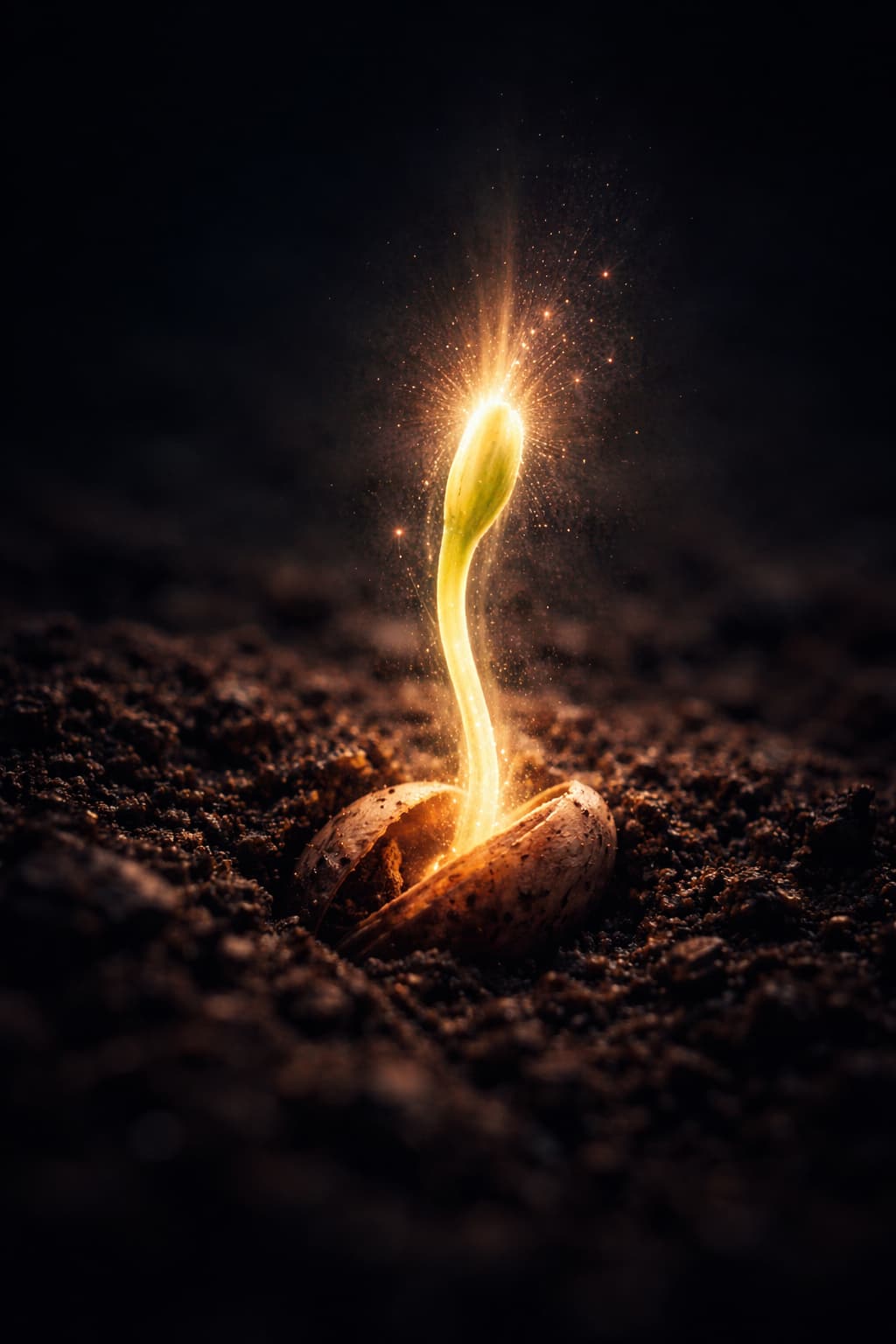
Not a religion or an institution, not even a system of rules to obey under threat of punishment. But a seed.
The seed of recognizing our own divine nature—that spark of the Creator carried within each of us, making every human being, without exception, capable of manifesting light in matter.
That seed was buried under centuries of dogma, fear, and organized guilt.
But a buried seed is not a dead seed.
Today, something is rising. You can feel it in the acceleration of awakenings, in the multiplying number of people who refuse imposed narratives, in that growing thirst for authenticity and meaning that cuts across every culture and every generation. This is not a political movement.
It is not a social trend.
It is something far deeper: an awakening that follows its own timeline, independent of whatever power structures do to delay it.
Reconnecting to our deepest nature is not a spiritual luxury reserved for those who have time to meditate. It is a fundamental act of resistance.
Because the person who knows who they are can no longer truly be convinced they are something else.
The one who has touched—even once, even briefly—that quiet inner certainty carries within them a fixed point that nothing can erase.
An inner reference that makes manipulation recognizable, not through cold analysis, but through simple dissonance. Something does not feel right.
And that perception, once sufficiently developed, is worth more than any fact-checking.
Fear drags us down. It contracts, closes, isolates, exhausts. It plunges us into darkness. It cuts us off from that inner source which is our most real strength.
Connection to our deepest nature does exactly the opposite. It elevates. It opens. It connects. It illuminates. It restores the creative power we have always carried—the one others have always sought to capture for their own gain.
Caring for that connection—through silence, through nature, through acts of kindness, sincere sharing, a simple smile at another, through everything that raises the vibrational frequency rather than lowering it—is not a retreat from the world.
It is the most sovereign gesture there is. It is choosing to nourish what no one can confiscate from us.
And it is, ultimately, the only response that truly holds in the
face of everything we have walked through together in these pages.
We Don’t Talk Enough About What It Really Costs.
There is something that discourses on awakening and sovereignty almost always omit, perhaps out of modesty, or for fear of discouraging those beginning the path. It is the human and relational toll of this process.
The concrete, sometimes painful price we pay when we stop being what others needed us to be.
Because this is what happens, inevitably.
When we begin to see the mechanics of manipulation, not only in media or power structures, but in daily relational dynamics, something changes in the way we are with others.
We start setting boundaries where we set none. We refuse roles we had played for years without having chosen them.
We stop validating narratives we no longer believe. We stop letting ourselves be guilt-tripped, infantilized, manipulated—even by people we love.
And some cannot bear it.
Not because they are evil. But because our transformation destabilizes an equilibrium they depended on. Because our new boundaries close doors that were previously wide open for them.
Because our refusal to play the game calls into question dynamics that suited them, consciously or not. So they leave, or they attack. Often, they drift away gradually, without explanation, as if our change were a form of betrayal.
That solitude is real. It would not be honest to minimize it.
But here is what experience teaches those who have had the courage to make this crossing all the way: the relationships that disappear in this process were not relationships between two free beings. They were constructions founded on an imbalance. On the fact that we agreed to diminish ourselves, silencing ourselves, bending ourselves to maintain a peace that was not really peace.
What awakening reveals is the true nature of bonds, and this revelation, however painful, is a gift.
Setting boundaries is not closing doors definitively. It is simply ceasing to leave open the doors through which people entered to take what we had not chosen to give. Those who accept these new boundaries, who respect who we are becoming—they stay. And these relationships, often fewer but infinitely more real, are worth all the circles of belonging we may have lost. The solitude of the path is not a punishment. It is a passage. And on the other side of this passage, we do not necessarily find a crowd, but real people. And above all, we find ourselves.
Finding True North: The Anchors of Sovereignty
What follows is not a program to follow to the letter, nor a list of good resolutions. These are points of return, simple, concrete gestures to come back to when the fog thickens, when external pressure grows stronger, when we feel ourselves drifting toward old reflexes of submission.
Regulate your information flow. Consciously choose what you let in, in quantity and quality. Space out your news consumption, whatever the source. Systematically ask yourself after each exposure to a narrative: what emotional state does this leave me in? If the answer is fear, constant outrage, or powerlessness—turn away.
Choose your sources with discernment, without ever believing them blindly. Turning away from mainstream media whose editorial lines serve interests that have nothing to do with information is a necessary first step.
But choosing alternative sources does not mean granting them blind trust.
Discernment applies everywhere, without exception.
And remain open to the uncomfortable possibility that the truth may lie far beyond what we already believe we know—because sometimes, what seems most improbable is precisely what has been most carefully hidden from us.
Learn to observe your thoughts. Not only your emotions, but the stories the mind fabricates, often without your knowledge, from your past wounds.
A gaze that lingers a second too long, a misconstrued word, a silence, and the mind can construct an entire narrative of conflict, betrayal, and aggression in moments.
These constructions say nothing about external reality. They speak of your unresolved inner patterns, inherited from old wounds you carry without always being conscious of them.
It is often in moments of relaxation, a walk, a car ride, that these mechanics show themselves most clearly: when the mind ceases to be occupied and begins to wander freely.
Observing them without fighting them, without identifying with them, without resenting yourself for having them, is already a form of liberation. You do not struggle against these thoughts. You recognize them, thank them for showing you what still seeks transformation, and let them pass.
Learn to Feel Again. Breaking free from manipulation also means restoring a capacity that years of conditioning have progressively anesthetized: the ability to feel inner dissonance.
That subtle sensation that something feels off, that a narrative rings false, that a situation is not right for us. Many have lost access to this inner signal.
Finding it again requires patience, silence, and gentle attention to our own sensations, before even seeking to analyze them. This is a path worth exploring in depth, and we will return to it.
Set relational boundaries without guilt. Identify relationships and dynamics that operate on manipulation, guilt-tripping, or judgment, and gradually stop participating in them.
Not through hostility, but through self-respect. Setting a boundary is not closing a door definitively. It is ceasing to leave open a door through which people entered to take what we had not chosen to give.
The bonds that survive these new boundaries are the only ones worthy of our energy. Choose what elevates rather than what weighs you down.
Nature, silence, creativity, authentic exchanges, everything that restores rather than exhausts. Treat these spaces not as luxuries but as necessities.
They are the conditions in which discernment develops and inner connection strengthens. Our vibrational frequency is not an esoteric abstraction; it is the concrete state from which we perceive, think, and create.
Caring for it is an act of sovereignty in its own right. Share without trying to convince. Offer a perspective, bear witness to an experience, ask a thought-provoking question, without exhausting yourself trying to force the awakening of those who are not ready.
The seed sown in good soil germinates in its own time.
Our role is to sow it, not to force the sprout. And sometimes, simply being—free, grounded, sovereign—is the most powerful transmission there is.
Return regularly to your deepest nature. Whatever form it takes, meditation, time in nature, prayer, conscious silence, cultivate daily that inner space where the noise of the world does not penetrate.
That is where the compass lies. That is where we find true north when everything seems disorienting. And it is there, in that inhabited silence, that our creative power ceases to be captured by others and becomes again what it should never have ceased to be: ours.
These anchors are not definitive solutions. They are practices, gestures that, repeated consistently, end up transforming not only our relationship to the external world, but our relationship to ourselves. Some of these doors deserve to be opened far beyond what these lines can contain.
We will explore them together, in greater depth, for those who wish to go all the way.
Conclusion
This is not an end. It is a beginning.
We set out together from a scene thousands of years old: a crowd kneeling before a deified pharaoh, incapable even of imagining the possibility of rising. We traversed the centuries, observed the mechanics perfecting themselves, becoming more sophisticated, rendering themselves invisible. We named the techniques, identified the levers, recognized the changing faces of a single project: keeping the human being at a distance from their own power.
And here we are: not at the end of a path, but at the beginning of another.
Because understanding is only the first step. The most fragile, too. Paradoxically, the one where we risk stopping, convinced that having seen is enough.
But seeing the bars of a cage, as we have said, does not open the door. What opens the door is movement. The decision, renewed each day, to live consistently with what we have understood.
This movement does not need to be revolutionary to be powerful. It begins in the most ordinary gestures. In the decision to cut off the constant fear-driven feed tonight rather than tomorrow. In the question we dare to ask aloud where we would have remained silent for fear of others’ judgment.
In the boundary calmly set on a relational dynamic that had been diminishing us for too long. In the choice to spend an hour in nature rather than before a screen.
In the conflicting thought we watch pass by without clinging to it,
with that new gentleness we are learning to have toward ourselves.
Each of these gestures is a declaration of sovereignty. They do not make newspaper headlines. They do not provoke visible revolution.
But they transform, silently and irreversibly, the inner landscape from which we perceive the world and from which we create. And a being who creates from their light rather than their wound, from their connection rather than their fear, is someone whom systems of manipulation no longer truly know how to reach.
This is real sovereignty. Not a definitive state reached one day and possessed forever. It is a direction, a choice that renews itself endlessly.
A commitment to something within us that resists everything we have been made to believe for far too long.
The humanity we truly are, luminous, creative, connected to something greater than ourselves, has never truly disappeared beneath the layers of conditioning. It has waited. It still waits, in some of us. But more and more, it rises.
And every consciousness that rises awakens others.
This is how things change.
Not through force, not through violence, not through the spectacular revolution we were taught to expect as the only form of possible transformation. But through the silent propagation of an awakening that needs no permission to exist.
We need no permission to exist in our full power. We never have.
Sources and references for this article (click to expand)
- Kazakhstan: sale and lease of agricultural land to foreigners prohibited
- How to throw rogue bankers in prison: Iceland’s ten lessons
- Iceland: Emerging from Crisis Differently
- Gandhi begins the “Salt March”
- Independence of India and Pakistan