
The Asian Paradox
“A paradox is only a truth seen from the wrong angle.”
🔍 Short on time? Here is the summary of this page:
• Asians stayed lean not because of rice, but because of a frugal, highly active lifestyle low in sugars.
• Their traditional diet contained no modern wheat, no gluten, no industrial oils, no snacks and no desserts: rice was the only major carbohydrate, within a healthy metabolic terrain.
• Their high metabolic flexibility let them use this glucose quickly, without causing hormonal or inflammatory dysregulation.
• The arrival of the Western model (sugars, seed oils, processed foods and a sedentary lifestyle) saturated their metabolism even though rice consumption had not changed.
• Rice was never a “magic” food, and it in no way proves that grains cause no problem. It was simply tolerated because it was consumed within a coherent way of life.
✨The paradox was never in the rice, but in the life that surrounded it.
🎧 Audio version of the page
Page audio available only with the Premium membership
Explore the page
The Common Misconception: “Asians Eat Rice and Stay Slim”
This is one of the most frequently repeated arguments whenever the dangers of carbohydrates come up: “Asians eat rice three times a day and yet they are slim, healthy and don’t have heart attacks. So the problem can’t come from grains or carbohydrates.” This conclusion seems logical at first glance, but it rests on a superficial observation. It takes no account of the biological, cultural, metabolic and dietary context in which rice was eaten for centuries. The human body does not react to a single food in isolation, but to the whole set of factors that make up a complete metabolic environment. When that context changes, the effect of the food changes too, sometimes radically. The Asian “paradox” exists only because we look at one detail without seeing the whole.
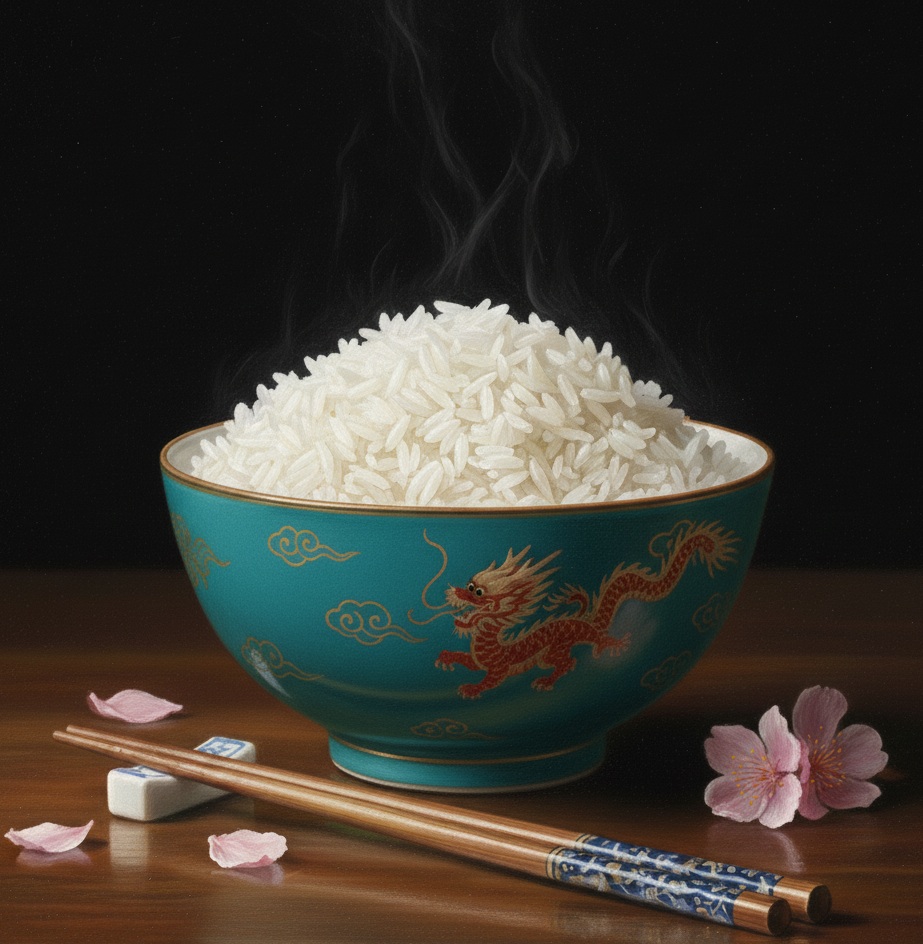
Why This Paradox Is Misleading
The argument seems solid, but it rests on a major confusion: it compares a traditional Asian reality with a modern Western one. Yet these two contexts have nothing in common. The paradox vanishes as soon as we look at the fundamentals: Asians did not eat only rice; they lived in a completely different metabolic environment, marked by high daily physical activity, an almost total absence of sugar, few or no processed foods and a diet very rich in natural animal fats. Their metabolism remained flexible, alternating between glucose use and fat-burning. Nothing like the modern Western metabolism, saturated with fast carbohydrates, industrial oils, constant snacking and low-grade chronic inflammation. The “paradox” exists only if we isolate rice from the way of life that came with it. Once rice is put back into its context, everything becomes logical.
The Major Differences Between Traditional Asia and the Modern West
The mistake behind the Asian paradox comes from comparing traditional Asian rice with rice eaten within a modern Western lifestyle. These are two opposite biological worlds. For centuries, Asian societies developed in an environment that favoured optimal metabolic health: a simple diet, a low total carbohydrate load, natural fats, no processed foods, constant physical activity and very little chronic inflammation. In that context, rice was not a danger: it was a coherent fuel.
The modern West has built exactly the opposite: a sedentary life, snacking, added sugars, seed oils, chronic stress, a weakened microbiome, disrupted sleep and permanent low-grade inflammation. The same food therefore does not have the same impact depending on the state of the terrain. A robust metabolism can neutralise an occasional carbohydrate intake. A weakened metabolism, on the other hand, becomes dysregulated much more easily.
The Asian paradox disappears as soon as we observe these fundamental differences. It is not the rice that has changed: it is the biological terrain that is no longer the same.

Metabolic Flexibility in Traditional Asian Societies
One of the most decisive, and most overlooked, aspects of the Asian paradox is metabolic flexibility. Traditional Asian populations could shift naturally from one fuel to another, from glucose to fat, without difficulty. Their bodies were never saturated with carbohydrates as in the modern diet; they constantly alternated between storing energy, using glucose, burning fat and switching back again. This capacity is the foundation of a healthy metabolism.
Research confirms this link between a traditional way of life and metabolic health. A systematic review carried out in Asia (R. Harahap et al., 2022) shows that daily physical activity, combined with a simple, minimally processed diet, drastically reduces the incidence of type 2 diabetes. Similarly, the study by Z. Yu and colleagues (2017) on Chinese dietary patterns demonstrates that the traditional diet, rich in vegetables, fish and fibre and low in sugar, maintains excellent insulin sensitivity, whereas adopting the Western diet completely reverses this balance. These observations are reinforced by work on exercise and diabetes prevention (J. Roux, 2014), which confirms that regular physical activity restores metabolic flexibility and improves carbohydrate handling.
It is in this context that rice was perfectly tolerated: it was immediately used as fuel or offset by the natural phases of fat-burning. Nothing like today’s situation, where the Western body, saturated with fast carbohydrates, industrial oils and chronic inflammation, can no longer switch to fat. Without metabolic flexibility, even a moderate food like rice becomes a problem.
The paradox therefore lies not in the rice, but in the lost flexibility. Where traditional Asia had a metabolism able to absorb and regulate, the modern West has a metabolism locked into a single mode: constant reliance on glucose.
Traditional Asian Fats: An Often Forgotten Role
Another fundamental element of the Asian paradox is the type of fats traditionally used. Unlike the modern West, which drowns everything in industrial oils extracted from seeds (sunflower, maize, soy), traditional Asia cooked almost exclusively with natural animal fats. In China as in Japan, Vietnam or Korea, everyday cooking relied mainly on lard, duck fat or, more occasionally, small amounts of sesame oil.
This point is essential, because traditional animal fats support hormonal stability, insulin sensitivity and mitochondrial integrity. Research on Asian dietary patterns (D. Kim et al., 2024) shows that these fats are associated with better cardiovascular and metabolic health, as long as they are part of an unprocessed diet. Conversely, the massive introduction of industrial vegetable oils in the twentieth century, soybean oil in particular, corresponds exactly to the dramatic rise of diabetes and metabolic diseases in Asia (Z. Yu, 2017; FAO/WHO reports).
The effect is twofold:
Industrial oils increase inflammation and disrupt the omega-6/omega-3 balance.
They profoundly alter the insulin response, especially when combined with carbohydrates.
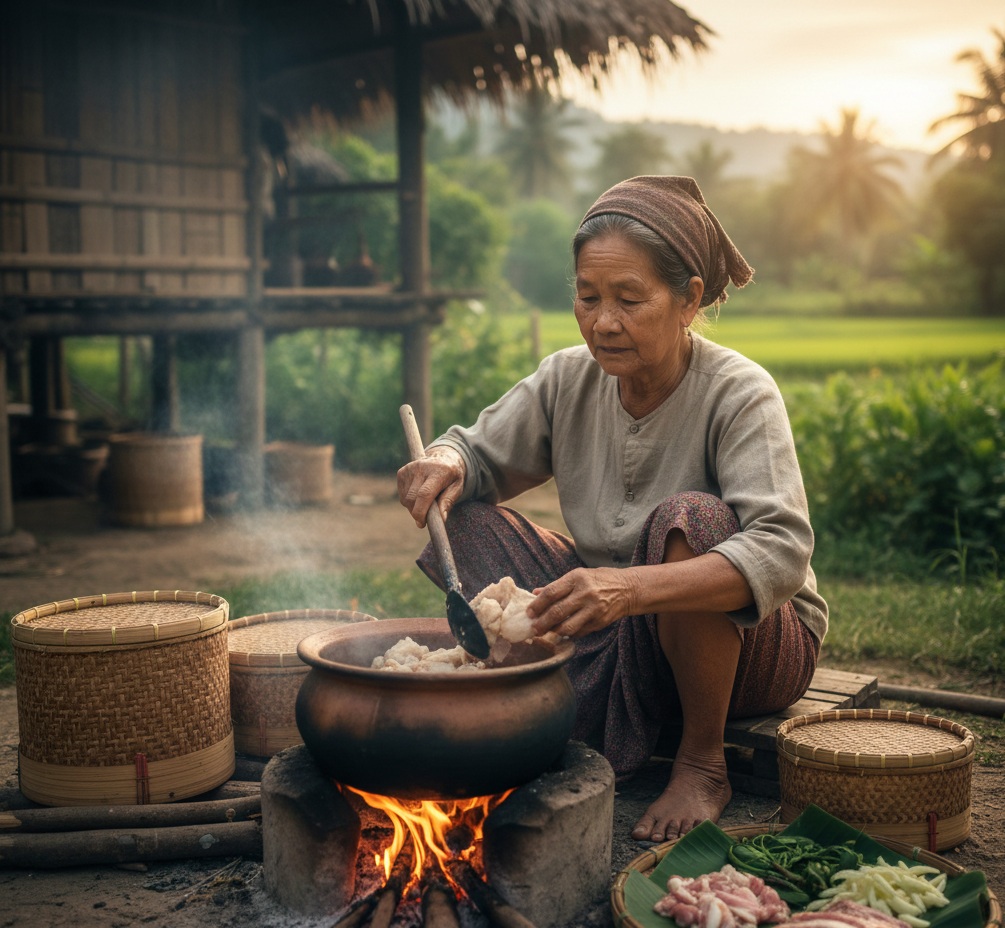
As long as Asia cooked with lard, rice remained a fuel compatible with a robust metabolism. As soon as industrial oils replaced traditional fats, that same rice stopped being neutral and began to contribute to the overall metabolic imbalance.
Here again, it is not the rice that has changed: it is the metabolic environment in which it is eaten.
Rice Was Not Eaten the Way It Is in the West
Traditional Asian rice cannot be compared with the rice eaten in the West today. Beyond the food itself, it is the way of preparing it, arranging it on the plate and fitting it into a day that changes everything. In Asia, rice was only the accompaniment to a meal built around vegetables, fish, broths or meats. Portions were modest, often two to three times smaller than those served in Europe or North America, and never played the role of dominant caloric base that we give them today.
The way rice was stored and prepared also changed its metabolic impact. It was common to cook rice in the morning, then keep it warm for several hours or let it cool before reheating it at the next meal. Some dishes were even eaten cold. These practices increase the proportion of resistant starch, which softens the glycaemic response, as Liu showed in 2015 in his work on starch digestibility. The same rice, eaten straight after cooking and in a Western-sized portion, has an entirely different effect on insulin.
The Asian food environment reinforced this natural protection further still. Meals were simple, with no added sugar, no desserts, no pastries, no snacks, and none of the industrial seed oils that heighten insulin resistance. Fermented foods, present everywhere, supported a robust microbiome, which further improves carbohydrate handling, as Yu and colleagues underline in their 2017 study on Chinese dietary patterns.
In this context, rice was never a burden on the metabolism. It was a coherent fuel, quickly used, buffered by the structure of the meal, offset by physical activity and neutralised by natural metabolic flexibility. So it is not the rice that has changed; it is the biological environment in which it is eaten that is no longer the same at all.
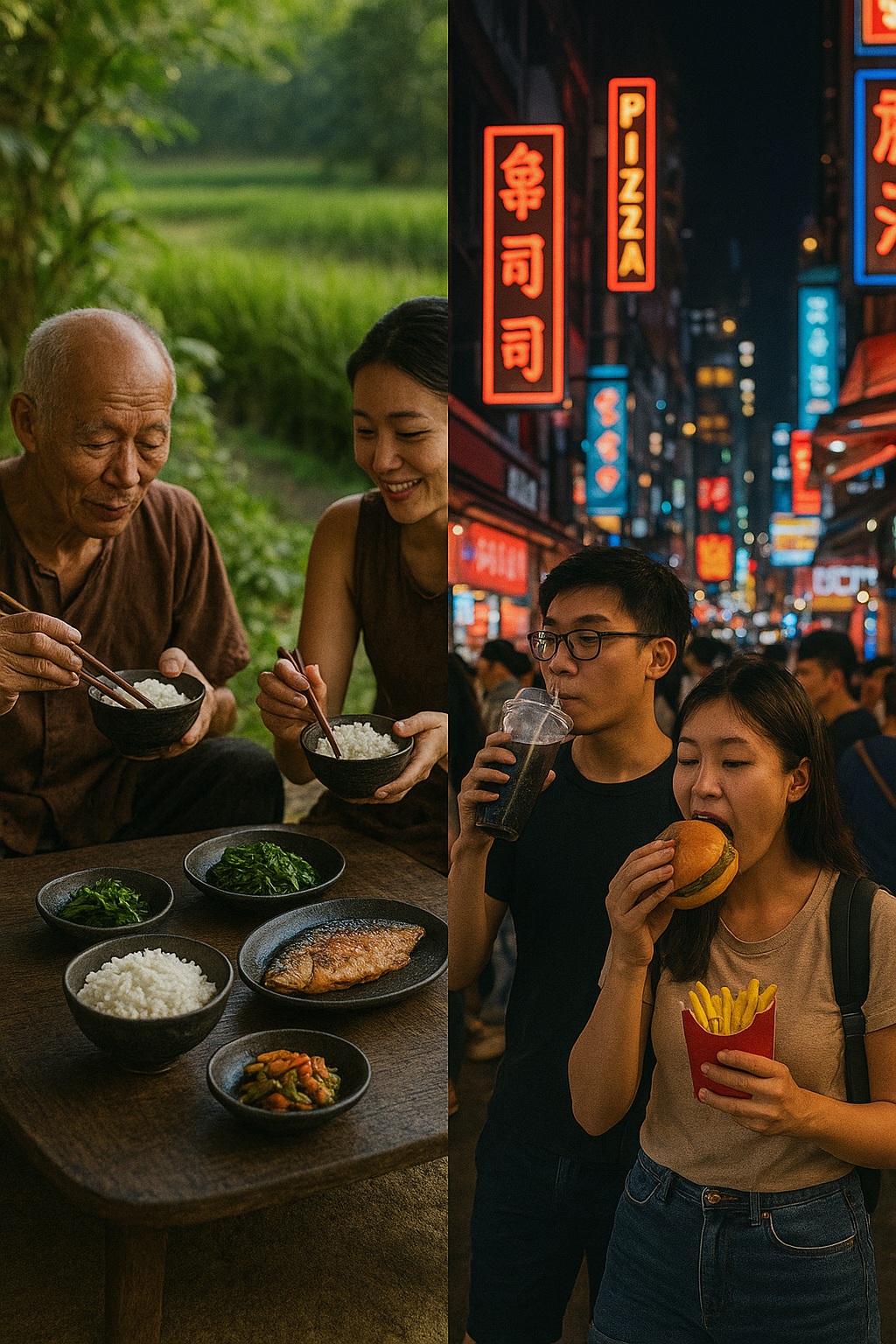
The Explosion of Metabolic Diseases in Asia
Asian populations consumed rice for centuries without widespread obesity or diabetes, but only because it was consumed within a way of life very different from ours. Asians ate no modern wheat, no gluten, no excess maize, no potatoes, no processed foods, almost no added sugar and very few desserts. Fruit existed, of course, but was eaten in small amounts, in season, and never in excessive amounts every day. Rice therefore remained their main source of carbohydrates, within an overall environment low in sugars.
When the Western dietary model arrived, with its industrial oils, snacks, sugary drinks, pastries and processed foods, the Asian metabolism was abruptly saturated. And since rice never disappeared, it simply became one more carbohydrate in an already overwhelmed system. Public health data from China, Japan and Korea (Yu et al., 2017; WHO) show a dramatic rise in diabetes and obesity with no notable change in rice consumption. So it was not rice that protected Asians: it was the simplicity and sobriety of their way of life.
Modern Asia is becoming ill for the same reason as the West: an overall excess of carbohydrates, industrial oils and processed foods. Rice was never a “magic” food. It was simply the only major carbohydrate within a way of life that made it possible to use it without metabolic drift.
Rice: The Only Non-Toxic Grain?
Unlike other grains, rice does not attack the gut: it contains no gluten, almost no anti-nutrients, does not stimulate immune receptors and does not alter intestinal permeability. Its only potential downside comes from its carbohydrate load, a problem that appears only when the metabolism is already saturated with sugars and unable to switch to fat-burning. For an active person with good metabolic flexibility, rice remains perfectly manageable.
For more than 3,000 years, traditional Chinese medicine has regarded rice as a major therapeutic food. It “nourishes the Spleen”, strengthens digestive Qi, stabilises the intestines and soothes inflammation. One of the oldest remedies, congee (zhou), is prepared by simmering one part rice in ten parts water for a long time; the resulting liquid is given to restore a weakened digestive system, calm diarrhoea, support recovery and rebalance the whole intestinal tract. Some schools even recommend combining three varieties of rice to amplify this restorative action.
This is why rice was always well tolerated in Asia: it was eaten within an active way of life, without an excess of other carbohydrates, and in a diet free of gluten, modern wheat and industrial oils. The Asian paradox is therefore nothing mysterious: rice, on its own, is not a biological problem. The problem appears only when the body, already saturated with carbohydrates and deprived of metabolic flexibility, can no longer manage its energy load.
White Rice, Brown Rice and Glycaemic Load: What Really Matters
Brown rice contains more fibre but also more anti-nutrients, in particular phytates that reduce mineral absorption. White rice is more digestible and is the one that has historically been eaten in Asia. Its glycaemic load varies greatly depending on how it is prepared: rice that has been cooled and then reheated develops more resistant starch, which lowers its glycaemic index and slows glucose absorption. This factor partly explains why, within an active and frugal way of life, rice did not cause metabolic imbalance despite its carbohydrate content.
Conclusion
The Asian paradox never lay in rice, but in the way of life that came with it. Despite a daily carbohydrate intake, Asians remained metabolically stable thanks to a frugal diet, modest portions, high physical activity and the absence of excessive intake from other carbohydrate sources, as well as gluten and aggressive anti-nutrients. Rice, low in anti-nutrients and highly digestible, interfered neither with nutrient absorption nor with hormonal balance.
It was therefore not the grain that explained their health, but their whole way of living. Once that context disappeared, the balance collapsed. The “Asian paradox” was never a mystery: it was simply a coherent way of life that the modern world has replaced.