
At the Heart of Mitochondria
“In every cell burns an ancient fire upon which all life depends.”
🔍 No time to read everything? Here’s the summary of this page:
- Your mitochondria decide who lives and who dies: every day, 50 to 70 billion of your cells die by apoptosis. It gives the order — and when this mechanism derails, cancer or neurodegeneration sets in.
- Mitophagy is your cellular self-cleaning system: a failing mitochondrion becomes a hotbed of destruction. Fasting triggers this process. Yoshinori Ohsumi received the 2016 Nobel Prize for demonstrating it.
- Your microbiota and your mitochondria govern each other: without butyrate produced by your good bacteria, your intestinal mitochondria collapse. Sugar, antibiotics, and stress break this alliance.
- We don’t age because time passes: we age because our mitochondrial DNA accumulates mutations. Douglas Wallace showed that all major degenerative diseases share this same root.
- Estrogens are a mitochondrial shield: they stimulate biogenesis, reduce ROS, and protect the brain. Their drop at menopause is not a hormonal detail — it’s a withdrawal of deep cellular protection.
- Depression, anxiety, and bipolar disorder may be energy diseases: Martin Picard (Columbia) demonstrated that psychological stress directly degrades mitochondrial function — and that the mitochondrion responds to your inner state.
- Your neurosteroids are born in the mitochondrion: pregnenolone, allopregnanolone — these molecules of clarity and calm are made from cholesterol on the inner mitochondrial membrane. Their decline explains far more than depression.
✨ Understanding what your mitochondria truly govern means understanding why everything — your energy, your hormones, your mood, your aging — holds together or collapses together.
🎧 Audio version of this page
Audio version of this page available only with a Premium membership
Explore this page
We know what the mitochondrion truly is: not merely a power plant, but a living being of bacterial origin, carrying a memory two billion years old. We know it manufactures our hormones, that it dialogues with our gut, that it carries the memory of our maternal lineage, that it produces both light and heat — and that it silently decides our vitality or our exhaustion.
But all of that was only the threshold.
What follows is what most sources do not touch. Not because it is inaccessible, but because it demands going further than standard popularization, further than ATP infographics, further than lists of superfoods, further than generic advice on “cellular well-being.”
Here, we go all the way to the root.
How the mitochondrion decides that a cell must die.
How the body cleanses its own damaged mitochondria and why our modern lifestyle has nearly extinguished this mechanism.
Why women age differently from men, and the precise role of estrogen in mitochondrial protection.
Why mitochondrial dysfunction is now documented as a common root of many chronic diseases, from cancer to depression, from Alzheimer’s to diabetes.
And finally — the most rarely explored territory:
how the state of our mitochondria influences our states of consciousness, our inner clarity, and our cognitive sovereignty.
This is not philosophy. This is biochemistry.
And it may be one of the most important things we can understand about ourselves.

The Mitochondrion Decides Who Lives and Who Dies
We have seen that the mitochondrion produces energy, manufactures hormones, regulates heat, and communicates with our gut.
But there is one function that is rarely discussed, and it may be the most staggering of all.
The mitochondrion decides the death of our cells.
Not by accident. Not by failure. In a deliberate, orchestrated, vital way.
This process is called apoptosis, from the Greek apo (separation) and ptosis (falling). Literally: the falling of leaves. A programmed, clean, silent death that allows the organism to constantly renew itself without triggering inflammation.
Every day, our body eliminates between 50 and 70 billion cells through apoptosis. And replaces them. This is how we stay alive. Not despite cell death, but because of it.
The mitochondrion is at the heart of this mechanism. It receives the signals indicating that a cell is too damaged, too old, or potentially dangerous. It then releases a protein called cytochrome c, an execution signal that triggers an irreversible cascade leading to the orderly dissolution of the cell.
When this mechanism works perfectly, dangerous cells die before they become a problem. The body cleans itself with remarkable precision.
But when the mitochondrion malfunctions — when it is exhausted, damaged, or saturated with oxidative stress — this signal goes awry.
Two scenarios can then emerge.
Healthy cells may receive the signal to die too early. This is what we observe in certain neurodegenerative diseases like Alzheimer’s or Parkinson’s, where still-useful neurons self-destruct prematurely.
Or conversely, dangerous, damaged, potentially cancerous cells no longer receive the signal to die. They survive, multiply, and proliferate.
This is one of the most well-documented links between mitochondrial dysfunction and cancer. Not the only one. But one of the most direct.
The Great Cleanse — When the Body Eliminates Its Own Mitochondria
We have just seen that the mitochondrion can decide the death of an entire cell.
But there is an even subtler process, just as vital. A process by which the body does not eliminate the entire cell, but only the damaged mitochondria inside that cell. It identifies them, isolates them, destroys them, and recycles them. Cleanly. Surgically. Without touching the rest.
This process is called mitophagy. Literally: eating one’s own mitochondria.
It is one of the most powerful regeneration mechanisms our biology has ever developed.
A damaged mitochondrion no longer produces energy properly. Instead, it generates excessive amounts of free radicals — those ROS we discussed — which poison their immediate environment and accelerate the aging of surrounding tissues. A failing mitochondrion that survives is worse than an absent one. It becomes a focal point of silent destruction at the very heart of the cell.
Mitophagy is nature’s answer to this problem. The body detects mitochondria whose membrane potential has dropped — a signal that something is no longer working correctly — and triggers their selective elimination. Recoverable components are recycled. The rest is disposed of.
This is a cellular deep clean. And like any deep clean, it requires time, calm, and a break from ordinary activity.
This is precisely where our modern lifestyle poses a fundamental problem.
Mitophagy is primarily activated during periods of fasting and caloric restriction. When the body is no longer digesting, when insulin is low and glycogen reserves begin to deplete, the cleanup signal is triggered. This is the biology of metabolic rest.
Yet we hardly ever stop. We eat from morning until night. We keep our insulin constantly elevated. We never give the body the window it needs to perform this cleanup work.
The result is silent but cumulative. Damaged mitochondria accumulate. Cells function less and less efficiently. Energy declines. Inflammation rises. And we age faster than our biology intended.
Researcher Yoshinori Ohsumi received the Nobel Prize in Medicine in 2016 for his work on autophagy, the process of which mitophagy is a specialized form. This is not a fringe territory. This is fundamental biology, recognized at the highest level.
And the good news is remarkable: mitophagy can be reactivated. Regular intermittent fasting, even moderate, is enough to reopen this cleanup window. The body knows exactly what to do. It is simply waiting for us to give it the opportunity.
Two invisible worlds that govern each other
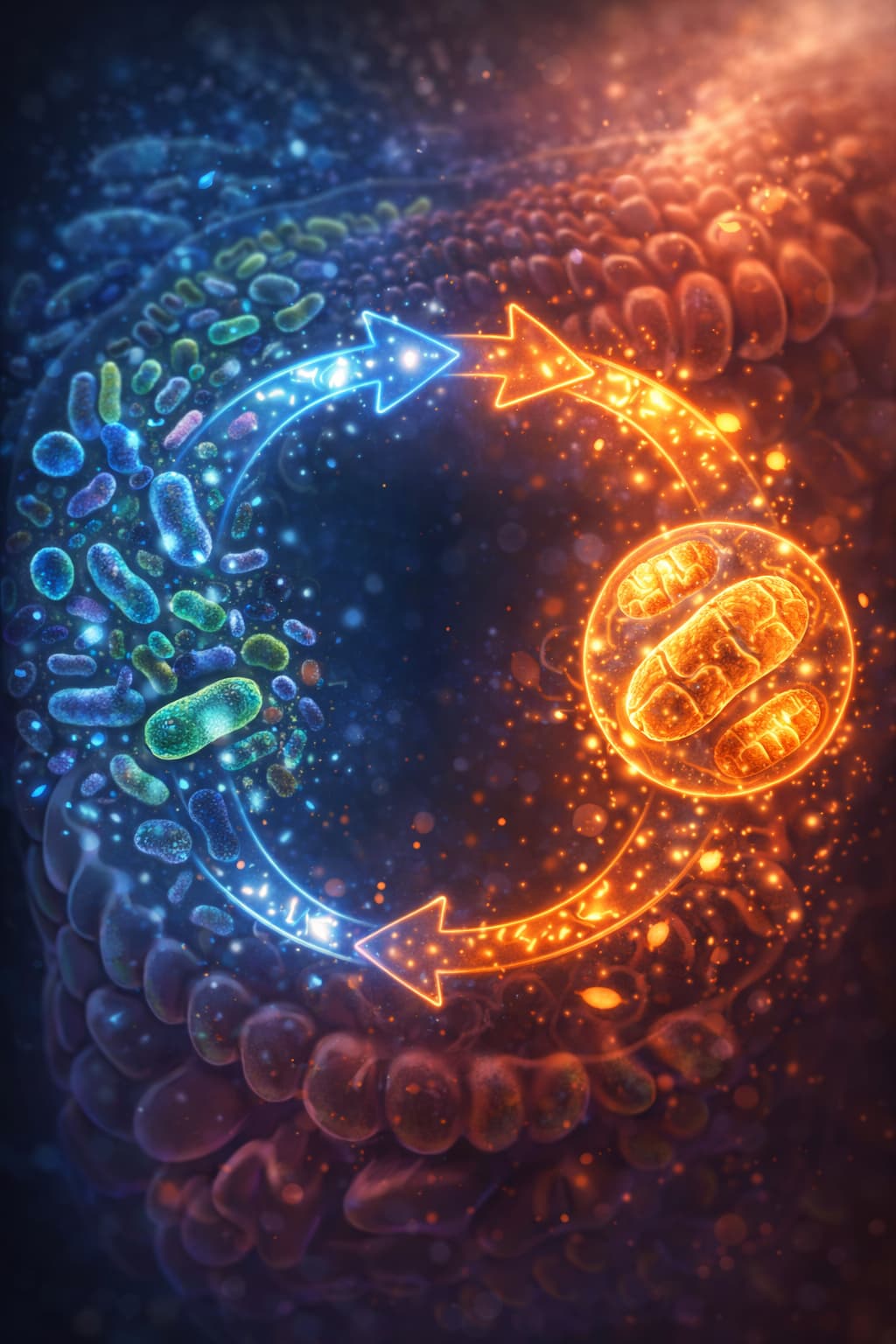
The free page opened this door. We saw that the microbiota and the mitochondria are in constant communication, that the butyrate produced by beneficial gut bacteria directly fuels the mitochondria of colon cells, and that without this fuel the intestinal wall weakens and inflammation sets in.
But this dialogue goes far deeper than that.
What science is beginning to document is truly dizzying. The mitochondria and the microbiota do not merely exchange metabolic signals. They co-regulate each other. The state of one conditions the state of the other, in both directions, constantly — with every meal, every stress, every night of sleep.
Here is what this dialogue means in concrete terms.
The microbiota produces far more than butyrate. It synthesizes numerous metabolites that directly influence mitochondrial biogenesis — the body’s ability to produce new mitochondria. Certain beneficial bacteria generate molecules capable of activating PGC-1α, one of the master regulators of mitochondrial multiplication.
An impoverished microbiota therefore also means slowed mitochondrial biogenesis. Fewer new mitochondria. Less available energy. Accelerated aging.
In the other direction, mitochondria also influence the intestinal environment. When they are in a state of oxidative stress, they alter the metabolism and chemical balance of the intestinal mucosa. This altered environment favors the proliferation of pathogenic bacteria at the expense of beneficial ones. The microbiota degrades. And a degraded microbiota in turn sends inflammatory signals that worsen mitochondrial stress.
It is a circle. Virtuous when balance is maintained. Vicious when something goes awry.
And what triggers this dysregulation is precisely what our modern lifestyle concentrates every day.
Excess sugar feeds pathogenic bacteria while overwhelming mitochondria with a glucose influx they cannot always manage efficiently. Antibiotics deplete the microbiota and can also disrupt mitochondria due to their shared bacterial origin. Chronic stress alters intestinal permeability and drains cellular energy reserves. Artificial light at night disrupts the circadian rhythm that governs both microbiota composition and mitochondrial dynamics.
Everything is connected. Everything responds to everything else.
What we now understand — and what conventional medicine is only beginning to integrate — is that treating the gut without considering the mitochondria, or treating the mitochondria without considering the gut, is like healing half of a system that only functions as a whole.
Microbiota and mitochondria: two worlds that medicine still treats separately
Gastroenterology treats the gut. Internal medicine treats metabolism. Neurology treats the brain.
Each in its own lane. Each with its own protocols. Each without always looking at what is happening next door.
Yet science is becoming increasingly clear: microbiota and mitochondria form a tightly linked system.
What disrupts one disrupts the other. What regenerates one regenerates the other.
An antibiotic treatment without microbiota support also weakens the mitochondria.
A diet that impoverishes the microbiota also weakens cellular energy production.
As long as medicine continues to treat these two worlds separately, it risks managing symptoms without ever reaching the root.
We don’t age because time passes
This is one of the most deeply rooted ideas in our culture. Time passes, the body wears down, aging sets in. An obvious fact. An inevitability.
But modern biology tells a very different story.
We don’t age because time passes. We age because our mitochondria accumulate damage faster than they can repair it. Time is not the cause. It is the framework within which a very specific, documented, and partially reversible biological process unfolds.
This is what geneticist Douglas Wallace of the University of Pennsylvania has dedicated his career to demonstrating. His work, now recognized as foundational to mitochondrial genetics, puts forward a central thesis: the progressive accumulation of mutations in mitochondrial DNA is one of the primary mechanisms of aging and degenerative diseases.
Let us recall: mitochondrial DNA is infinitely more vulnerable than nuclear DNA. It is exposed directly at the heart of the energy machinery, where the most oxidizing reactions of the cell take place. It mutates up to ten times faster. And its repair capabilities are far more limited.
Over the years, these mutations accumulate. Damaged mitochondria produce less energy and more free radicals. These excess free radicals in turn damage other mitochondria. A vicious cycle sets in, silent and progressive, eventually affecting the most energy-demanding organs first: the brain, the heart, the muscles.
This is how, according to Wallace, the vast majority of age-related degenerative diseases arise. Not because of time. Because of the progressive exhaustion of the cellular forge.
But here is what changes everything: this process is not an inevitability carved in stone. Mitochondrial biogenesis — the body’s ability to create new, healthy mitochondria — remains active throughout our lives. It can be stimulated. It can be supported. And certain approaches, which we will explore in the training, show remarkable results in slowing this process.
Aging is inevitable. Aging fast is not.
Douglas Wallace: the man who rewrote our understanding of aging
Douglas Wallace is not just another researcher. He is the one who, since the 1970s, had the audacity to ask a question no one else was asking: what if most major degenerative diseases were not distinct illnesses, but different expressions of the same cellular energy collapse?
His work first mapped mitochondrial haplogroups — those great families of mitochondria that differentiated over the course of human migrations across continents. He showed that these variations are not trivial: some haplogroups confer better adaptation to cold climates, others to warm climates, and each carries a different susceptibility to certain diseases. Our mitochondria literally carry the memory of the territories our ancestors traversed.
His second major contribution is perhaps the most groundbreaking. Wallace demonstrated that Alzheimer’s, Parkinson’s, type 2 diabetes, certain cancers, and many cardiovascular diseases all share a common origin: a progressive failure of mitochondrial energy production. These are not separate diseases attacking separate organs. They are different faces of the same exhaustion of the cellular forge, manifesting where the affected organ is most vulnerable and most energy-demanding.
His third idea is that of the energy threshold. A cell can tolerate a certain percentage of damaged mitochondria without tipping into disease. As long as healthy mitochondria compensate, the system holds. But when the threshold is crossed — when damaged mitochondria become the majority — the cell collapses abruptly. This threshold is not the same for all organs. The brain and heart, which consume the most energy, collapse first. This explains why neurodegenerative and cardiovascular diseases dominate the picture of pathological aging.
Wallace does not speak of fate. He speaks of mechanics. And mechanics can be understood, protected, and sometimes repaired.

What menopause really reveals
Why do women live longer than men on average? Why do they develop cardiovascular and neurodegenerative diseases roughly ten years later? Why does their energy decline accelerate so abruptly after menopause?
The official answer cites behavioral factors, lifestyle choices, and generic hormonal differences. That’s true but incomplete. The real answer is far more precise and far more fascinating.
Estrogens are direct mitochondrial protectors.
This is not a metaphor. It is a documented mechanism. Estrogens, particularly estradiol, bind to receptors located directly on the mitochondria. They stimulate mitochondrial biogenesis — the creation of new, healthy mitochondria. They increase the efficiency of the respiratory chain, thereby improving the energy yield of each mitochondrion. They reduce free radical production. And they support mitochondrial DNA repair mechanisms.
Throughout a woman’s reproductive life, estrogens keep her mitochondria in a state of relative protection. This is one of the deep biological reasons why women resist degenerative diseases better and for longer.
Then menopause arrives. Estrogens plummet. And mitochondrial protection collapses with them.
It is no coincidence that cardiovascular disease, Alzheimer’s, and chronic fatigue explode in women during the years following menopause. It is not aging alone. It is the brutal withdrawal of a mitochondrial shield these women had carried since puberty without even knowing it.
Researchers Roberta Brinton of the University of Arizona and Phyllis Wise have documented this link with remarkable precision. Their work shows that the female brain is particularly dependent on estrogens to maintain its mitochondrial biogenesis, and that the estrogen drop of menopause represents a moment of real and measurable neurological vulnerability.
What this implies for every woman going through this transition is profound. Menopause is not merely the end of a reproductive cycle. It is a major biological signal that calls for particular attention to mitochondrial health. Not to fight menopause, but to understand what it reveals and what it demands.
What No One Tells Women Entering Menopause
Menopause is presented as a natural transition to be endured with patience. We hear about hot flashes, mood swings, dryness. Hormone replacement therapy is sometimes prescribed. And then we move on.
What is almost never discussed is what happens at the deep cellular level. The drop in estrogen is not just a matter of comfort or a finished reproductive cycle. It is the withdrawal of a mitochondrial shield that had been protecting every cell in the body since puberty. A shield that kept mitochondrial biogenesis active, limited oxidative stress, and supported cellular DNA repair.
When that shield disappears, mitochondria age faster. The brain becomes more vulnerable. So does the heart. Available energy declines. And all of this happens silently, long before blood tests show anything abnormal.
This is not a death sentence. It is information. And information allows you to act. Supporting your mitochondria during and after menopause is not a luxury. It is one of the smartest decisions a woman can make for her long-term health.
When the Forge Goes Out, Everything Collapses
We have explored what the mitochondrion does when it functions correctly. We have seen how it ages, how it cleans itself, and how it protects itself with the help of estrogens.
Now it is time to look at what happens when it truly malfunctions.
Mitochondrial dysfunction is not a rare disease. It is not an exotic diagnosis reserved for a few particular clinical cases. Today, it is one of the most studied mechanisms in modern medicine, recognized as a silent root of many chronic diseases affecting our societies.
The link is direct: without sufficient cellular energy, no organ can function properly. No system can repair itself. No defense can hold.
The brain consumes about 20% of the body’s total energy for only 2% of its mass. When the brain’s mitochondria become depleted, neurons become more vulnerable, synaptic connections degrade, and the brain’s cleaning mechanisms work less efficiently. It is in this context that diseases like Alzheimer’s, Parkinson’s, and certain forms of dementia develop.
The heart beats about 100,000 times a day without ever stopping. It is one of the most energy-demanding organs in the body. Its cells contain up to 5,000 mitochondria each. When these mitochondria malfunction, the heart muscle weakens, arrhythmias appear, and heart failure can set in.
The pancreas produces insulin, which regulates our blood sugar. This production depends directly on mitochondrial energy. When the mitochondria of pancreatic cells become depleted after years of glycemic overload, insulin secretion degrades. That is type 2 diabetes seen from its metabolic root.
Cancer cells very often exhibit profound mitochondrial dysfunction. They lose the ability to produce their energy normally and switch to an inefficient glucose fermentation, a phenomenon known as the Warburg effect. They also lose the apoptotic signal that should trigger their death.
Researcher Thomas Seyfried of Boston College has dedicated his work to exploring the idea that cancer is fundamentally a metabolic disease linked to mitochondria, and that this perspective opens up therapeutic pathways very different from those currently taken by conventional medicine.
Chronic fatigue, fibromyalgia, irritable bowel syndrome, certain autoimmune diseases, and some forms of treatment-resistant depression often share a common point: mitochondria that no longer produce enough energy for the body to regulate, repair, and defend itself properly.
This is not a fringe hypothesis. It is a direction toward which many researchers in cell biology and metabolic medicine are converging today.
Mitochondrial Dysfunction and Chronic Diseases: Mapping the Territory
Neurodegenerative diseases
Alzheimer, Parkinson and multiple sclerosis all share a documented mitochondrial substrate. In Alzheimer’s, mitochondrial dysfunction precedes the appearance of amyloid plaques by several years, suggesting it is not a consequence of the disease but one of its triggering mechanisms. In Parkinson’s, the dopaminergic neurons of the substantia nigra are particularly vulnerable to mitochondrial depletion due to their intense and continuous electrical activity. In multiple sclerosis, recent studies show that demyelination is aggravated by the inability of neuronal mitochondria to supply the energy needed for myelin sheath repair.
Metabolic diseases
Type 2 diabetes begins in the mitochondria of the pancreatic beta cells, long before blood glucose becomes problematic. Chronic glucose overload exhausts their ATP production capacity, degrades insulin secretion, and progressively installs insulin resistance in muscle and liver cells. Pathological obesity is associated with a significant reduction in the number and efficiency of mitochondria in muscle and adipose tissues.
Cardiovascular diseases
The cardiac muscle is the organ most dependent on mitochondrial energy in the entire body. Heart failure is now recognized by several research teams as a bioenergetic disease before being a mechanical disease. The cardiac mitochondria of heart failure patients show a marked reduction in respiratory efficiency and an increase in local oxidative stress.
Cancers
The abnormal energy metabolism of cancer cells, known as the Warburg effect, is one of the most universal signatures of cancer. Cancer cells abandon mitochondrial oxidative phosphorylation in favor of inefficient glycolysis, even in the presence of oxygen. They simultaneously lose the mitochondrial apoptotic signal that should trigger their elimination. Thomas Seyfried of Boston College argues that treating cancer as a mitochondrial metabolic disease opens therapeutic avenues that conventional medicine does not yet explore sufficiently.
Chronic fatigue and fibromyalgia
These two conditions, long misunderstood and sometimes denied by conventional medicine, consistently show measurable mitochondrial dysfunction in recent studies. Patients with chronic fatigue syndrome have significantly reduced ATP production in their immune and muscle cells. Fibromyalgia is associated with elevated mitochondrial oxidative stress in muscle tissue, which would explain the diffuse pain and heightened sensitivity characteristic of this condition.
Autoimmune diseases
Mitochondria play a central role in regulating the immune system. When they malfunction, they continuously send inflammatory alarm signals, as if the body were under permanent attack. This chronic inflammatory background noise is now recognized as an aggravating, even triggering, factor in numerous autoimmune diseases, including rheumatoid arthritis, lupus, and Hashimoto’s thyroiditis.
Depression may not be what we think it is
For decades, psychiatry has sought the cause of depression in a neurotransmitter imbalance. Too little serotonin. Not enough dopamine. The solution seemed simple: molecules to correct this chemical imbalance. Antidepressants prescribed to millions of people, with often mixed results and very real side effects.
But a fundamental question has long lingered in the background: why do these neurotransmitters become imbalanced in the first place?
Research is now beginning to explore a different answer.
Depression, chronic anxiety, and certain mood disorders may be, at least in part, disorders of cellular energy.
The brain is the most energy-hungry organ in the body. Its neurons work constantly, even during sleep. They depend on a steady, continuous flow of ATP. When brain mitochondria malfunction, this energy flow degrades. Neurons then have less energy to maintain their ion gradients, synthesize their neurotransmitters, and stabilize their synaptic connections.
An energetically depleted brain no longer regulates its emotions the same way. It becomes more vulnerable to stress, mood swings, and cognitive disturbances. This is not a matter of willpower or character. It is a matter of cellular biochemistry.
The work of Martin Picard at Columbia University has helped shed light on this connection. His research shows that mitochondria actively participate in the biological response to stress. Intense psychological stress can alter the structure and function of brain mitochondria. And altered mitochondria can, in turn, amplify the stress response, creating a loop of vulnerability.
In bipolar disorder, several brain imaging studies have observed anomalies in energy metabolism within certain prefrontal regions during depressive phases. During manic phases, metabolic activity can conversely increase sharply, suggesting unstable energy regulation.
In chronic anxiety, multiple studies have also highlighted a link with mitochondrial oxidative stress. A nervous system kept in a state of alert consumes enormous amounts of energy. Over the long term, this sustained energy demand can exhaust the mitochondria. And weakened mitochondria can contribute to keeping the organism in a state of hypervigilance.
This field of research is still young. Mitochondrial psychiatry is not yet a fully established discipline. But the data are progressively converging toward an idea that is difficult to ignore: the energy state of brain cells could play a central role in mental health.
What if part of treating depression also involved restoring the energy of the brain’s mitochondria?
What psychiatry never asks
When was the last time you ate for your brain?
When someone consults for depression, they are asked about their thoughts, their relationships, their traumas, their childhood. Rarely are they asked what they eat. Never are they told that their brain consumes 20% of the body’s total energy and that this energy depends entirely on the state of their mitochondria.
No one tells them that excess sugar, industrial oils, deficiencies in magnesium, zinc, B vitamins, and omega-3s directly sabotage their neurons’ energy production. That their brain may simply be exhausted. Not chemically imbalanced by some biological fate. But energetically drained by years of a lifestyle that never gave it what it needed.
This is not a denial of psychological suffering. It is an invitation to look beyond the symptom. A well-nourished, well-oxygenated brain with functioning mitochondria is not immune to depression. But it has infinitely more resources to weather life’s trials, regulate its emotions, and restore its balance.
The question that psychiatry almost never asks is perhaps the simplest and most fundamental of all: what is the state of this brain’s mitochondria?
Sugar and the forge: a silent war
We have already mentioned sugar as an enemy of mitochondria. But the precise mechanism by which it destroys them deserves to be clearly understood, because it lies at the heart of almost everything we have explored so far.
It all begins with insulin.
When we eat carbohydrates, our blood sugar rises. The pancreas secretes insulin to usher glucose into the cells. It is a perfect, elegant mechanism, designed to work with moderate, spaced-out carbohydrate intake — the kind our ancestors consumed.
That is not what we do.
We eat sugar from morning to night. We keep our insulin constantly elevated. And over time, glucose-saturated cells become resistant to the insulin signal. They close their doors. The pancreas then produces even more insulin to force entry. The resistance worsens. The vicious cycle sets in.
And at the heart of this cycle, mitochondria pay the heaviest price.
A chronic excess of glucose inside the cell overloads the mitochondrial respiratory chain. Electrons accumulate, spill over, and produce massive amounts of free radicals. This oxidative stress damages mitochondrial DNA, degrades membranes, and reduces energy efficiency. Mitochondria produce less ATP and more ROS. They age prematurely. They become dysfunctional.
And dysfunctional mitochondria in turn worsen insulin resistance, because muscle and liver cells need mitochondrial energy to respond properly to the insulin signal.
It is a perfectly destructive loop. Sugar exhausts mitochondria. Exhausted mitochondria worsen insulin resistance. Insulin resistance keeps sugar elevated. And the cycle continues, silently, for years, before type 2 diabetes is officially diagnosed.
This topic is explored in depth on a full page we have dedicated to it on SLAKE. Because it deserves it. Because understanding insulin means understanding one of the most destructive mechanisms of our time — and one of the most actionable.
To go further: Insulin: far more than a sugar hormone

Everything converges here
We have traversed an immense territory together.
We have seen how the mitochondrion decides the life and death of our cells. How it cleanses and regenerates itself. How it dialogues with our gut. How it ages and how that aging lies at the root of nearly all chronic diseases. How estrogens protect it. How its exhaustion manifests even in our most intimate psychological states.
It is time to connect all of this into a single vision.
Because what we have explored territory by territory actually forms an indissociable triangle. A triangle where each vertex conditions the other two. A triangle that, when in balance, produces something rare and precious: a human being fully alive, fully lucid, fully sovereign.
This triangle is that of the mitochondrion, hormones, and consciousness.
The mitochondrion manufactures hormones. All steroid hormones are born in the mitochondrion. Cortisol, testosterone, estrogens, progesterone, DHEA: all arise from the transformation of cholesterol inside the mitochondrion. Without functional mitochondria, no hormones. Without hormones, no physiological balance is possible. The body enters survival mode. Energy becomes scarce. Clarity disappears.
Hormones condition consciousness. This is not a metaphor. Steroid hormones cross the blood-brain barrier and act directly on the brain. They modulate our mood, our ability to concentrate, our resilience to stress, our emotional depth. A hormonal imbalance is not merely a physical problem. It is an alteration of our capacity to perceive, to feel, and to think freely.
And consciousness, in turn, acts on the mitochondria. This is the apex of the triangle that science approaches with the greatest caution, and perhaps the most fascinating of all. The work of Martin Picard at Columbia University shows that psychological state directly influences mitochondrial morphology and function. Chronic stress, rumination, persistent negative emotional states measurably alter mitochondria. Conversely, states of inner coherence, deep calm, meaning, and connection appear to protect them.
Our thoughts and emotions are not separate from our biology. They are an integral part of it. They speak to our cells. And our cells respond.
This triangle is not an abstract theory. It is the most concrete biological reality there is. To care for your mitochondria is to care for your hormones. To care for your hormones is to care for your inner clarity. And cultivating that inner clarity protects your mitochondria.
Everything holds together. Everything responds to everything else. All is one.
The molecules of inner sovereignty
We have spoken of steroid hormones. We have spoken of their link to mitochondria. But there exists a family of molecules even more subtle, even less known to the general public, that sits precisely at the intersection of biochemistry and consciousness.
These molecules are called neurosteroids.
They are produced directly in the brain, by glial cells and neurons themselves, from cholesterol that enters their mitochondria. They do not need to cross the blood-brain barrier from the blood: they are manufactured on site, for the brain, by the brain. And they act directly on the neuronal receptors that govern our deepest inner states.
The two most documented and most fascinating neurosteroids are pregnenolone and allopregnanolone.
Pregnenolone is often called the “mother of all hormones” because it is the precursor from which all other steroid hormones are synthesized: progesterone, cortisol, testosterone, estrogens, DHEA. But beyond this precursor role, it acts directly on the brain. It modulates NMDA receptors involved in memory and learning. It supports synaptic plasticity, that is, the brain’s ability to form new connections. Studies show that its levels are significantly reduced in depression, schizophrenia, and age-related cognitive disorders.
Allopregnanolone is perhaps even more remarkable. It acts on GABA-A receptors, the same receptors targeted by benzodiazepines and alcohol. It naturally produces an anxiolytic, calming, deeply stabilizing effect. It is the brain’s natural Valium, produced by its own mitochondria. Its levels drop dramatically in severe depression, intense premenstrual syndrome, post-traumatic stress disorder, and certain forms of treatment-resistant chronic anxiety.
In 2019, the US FDA approved a drug derived from allopregnanolone to treat severe postpartum depression. It was the first time a synthetic neurosteroid received this approval. A strong signal that conventional medicine is beginning, slowly, to look in this direction.
And the mitochondrion is at the heart of all of this. Without functional mitochondria in brain cells, neurosteroid synthesis collapses. The brain loses access to its own tools of regulation, stabilization, and clarity. It becomes more vulnerable, more reactive, less sovereign.
This link between brain mitochondria, neurosteroids, and states of consciousness is one of the most fertile and least explored territories in all of modern neurobiology. It suggests something profound: that our capacity to be present, stable, lucid, and inwardly free is inseparable from the state of our cellular forge.
To care for your mitochondria is also to care for your inner light.

The fire only asks to burn
We have reached the end of this journey. And yet, nothing we have just explored is an ending. It is an opening.
We now know what the mitochondrion truly governs. Not just energy. The life and death of our cells. The cleansing of our inner forge. The ongoing dialogue with our gut. The manufacture of our hormones. The protection that estrogens offer it and what happens when that protection disappears. The direct link between its exhaustion and the major chronic diseases of our time. Its deep connection to our psychological states, our mental clarity, our cognitive sovereignty. And finally, those extraordinary molecules known as neurosteroids, made by the brain for the brain, whose production depends entirely on healthy mitochondria.
All of this forms a coherent, documented, and deeply actionable picture.
Because the mitochondrion is not a death sentence. It responds. It adapts. It regenerates. It can be protected, nourished, rekindled. The tools exist. The studies are there. The protocols are concrete.
What we have just explored together is not theory. It is the map. And a map is only valuable if it leads somewhere.
The next step is to act. To transform this knowledge into real, daily cellular sovereignty. That is exactly what we have built into the training: the precise enemies, the documented protectors, the complete protocols, the practical tools to assess the state of your mitochondria and regenerate them step by step.
The fire has burned within you for two billion years. It asks only one thing: that we stop extinguishing it.
Sources and references of the article (click to expand)
- Cytochrome C-mediated apoptosis
- Nobel Prize in Physiology or Medicine – Yoshinori Ohsumi
- The Microbiome and Butyrate Regulate Energy Metabolism and Autophagy in the Mammalian Colon
- The interplay between mitochondria, the gut microbiome and metabolites and their therapeutic potential in primary mitochondrial disease
- A mitochondrial paradigm of metabolic and degenerative diseases, aging, and cancer: a dawn for evolutionary medicine
- A mitochondrial bioenergetic etiology of disease
- The healthy cell bias of estrogen action: mitochondrial bioenergetics and neurological implications
- Cancer as a mitochondrial metabolic disease
- Psychological Stress and Mitochondria: A Conceptual Framework
- Mitochondria in depression: The dysfunction of mitochondrial energy metabolism and quality control systems
- Mitochondrial dysfunction results from oxidative stress in the skeletal muscle of diet-induced insulin-resistant mice
- Pregnenolone sulfate as a modulator of synaptic plasticity
- The role of allopregnanolone in depression and anxiety