
Propaganda and Mass Manipulation
“The conscious and intelligent manipulation of the organized habits and opinions of the masses is an important element in democratic society. Those who manipulate this unseen mechanism of society constitute an invisible government which is the true ruling power.”
Edward Bernays
🔍 Short on time? Here’s the key takeaway:
- Mass manipulation is as old as power itself. From deified pharaohs to modern media, the methods have evolved, but the mechanics never have. Fear, guilt, control of knowledge, and a monopoly on the narrative remain the timeless pillars of domination.
- In the 20th century, manipulation became a science. The Milgram experiment proved it: ordinary people, neither sadistic nor foolish, can obey to the point of horror when a perceived legitimate authority gives the order.
- Eleven modern techniques work in synergy. From fear as the primary lever to infantilization, cognitive saturation, and disqualification through labeling, it’s never one isolated technique that traps you, but their constant interweaving.
- Infantilization is the most dangerous of all. It doesn’t just steal your freedom to act; it destroys your ability to understand that you even have that freedom. It’s the mother technique that makes all others invisible.
✨ Totalitarianism doesn’t begin with brutality. It begins the day control becomes normal, and no one finds it strange anymore.
🎧 Audio version of this page
Audio is available exclusively with the Premium subscription.
Explore this page

Power Is Born in Beliefs
The sun beats down on the white stone. Heat rises from the ground like an invisible haze, and the crowd has been gathered since dawn. No one really speaks. They wait.
Then a ripple moves through the bodies, almost imperceptible at first. Every gaze lifts in the same direction. Up there, between two monumental columns, a figure appears. Gold, fine fabrics, light. No one questions what he is supposed to be. Not a leader, not a king. A living god.
Around us, some are already kneeling. Others follow suit without thinking. The gesture spreads faster than any command. This isn’t a personal decision; it’s a collective reflex. In that precise moment, disobedience isn’t even a possibility that crosses the mind. We would probably have done the same.
Not because people were naive. Not because they were stupid. But because everything—the architecture, the stories, the priests, the symbols, the crowd itself—made it obvious: questioning was unthinkable.
Mass manipulation wasn’t born with television, or with the Internet, or even with modern politics. It began the day someone discovered that a human group could be steered without a single direct order. The day someone understood that a shared belief can become stronger than reality itself.
Since then, only the methods have changed.
The Origins of Mass Manipulation
Mass manipulation isn’t confined to the Middle Ages or the modern era. From Antiquity onward, religious and political powers deployed strategies to cement their authority. In ancient Egypt, pharaohs were presented as living gods, making any challenge a sacrilege. In Rome, emperors staged spectacles and entertainment to channel the population and deflect attention from social tensions and famines.
In the time of Yeshua, religious authorities weaponized fear to direct the accusations against him. These mechanisms, still rudimentary, already laid the groundwork for modern manipulation: using the fear of disorder to eliminate the one who speaks a truth. In the Middle Ages, these practices were refined and entrenched through religion wielded as an instrument of absolute terror.

Fear at the Heart of Mass Manipulation
In the Middle Ages, manipulation wasn’t a suggestion; it was violence at every moment. The Devil occupied a central place in people’s minds: not a concept, but a physical threat. Ecclesiastical authorities pointed to epidemics and natural disasters as proof of divine wrath, keeping the population in a state of submission through terror.
The peak of this human abjection came with the witch hunts. These women were often healers, the only ones who could cure with plants. The system’s perversion ran so deep that villagers, the very people who came to them secretly at night for treatment, became their denouncers the next day. Out of jealousy, fear, or a desire to curry favor with the inquisitors, they cast the first stones. Knowledge and compassion were burned at the stake to the cheers of a manipulated crowd. This capacity of human beings to betray their own brother or sister to please authority is the foundation on which every authoritarian system still rests today.
The Manufacturing of Collective Consent
Mass manipulation rests on pillars that cannot be broken unless they are identified.
First, the activation of fear: when an authority waves a threat, it short-circuits discernment to impose its solutions. Next, the monopoly of the narrative: when an authority holds the only interpretation of the world, it shapes reality. Then comes guilt: if misfortune is the consequence of a fault, everyone becomes their own policeman. You no longer obey merely out of fear of punishment, but out of fear of being morally “in the wrong” before the community. Finally, the control of knowledge locks the whole system in place. Yesterday, it was the ban on reading the Bible outside the clergy; today, it’s the disqualification of any information that doesn’t come from official channels.
That’s how collective consent is built: through the structuring of beliefs, the activation of fear, the internalization of guilt, and the concentration of knowledge.
The Birth of Modern Propaganda
For centuries, mass manipulation relied mainly on belief and fear. It remained local, tied to a community, a religion, a territory. With the industrial era, manipulation changed scale.
To send millions of men to die in the trenches in 1914, coercion was no longer enough; their consent was required. Propaganda became a state strategy.
Posters, newspapers, official speeches, images repeated endlessly: information was no longer simply transmitted; it was manufactured.
The relentless repetition of images and slogans turns lies into a truth shared by all. This is where manipulation stops being intuitive and becomes a scientific technique of crowd management.
The goal is no longer to describe reality but to produce a common perception. The enemy must appear dangerous, inhuman, and threatening. The more fear it inspires, the more necessary war seems.
Repetition becomes a weapon. An idea heard everywhere eventually looks like an obvious truth. Whether it’s verified hardly matters; what counts is that it’s shared. From that point on, fear is no longer just exploited. It’s organized.
Society enters a new era: one where public opinion can be steered on a massive scale. The method now exists. All that remains is to apply it in peacetime.
Manipulation Becomes Scientific
With the 20th century, a new turning point arrives. Mass manipulation no longer rests solely on the intuition of leaders or religious authority; it becomes an exact science. It now draws on psychology, sociology, and behavioral research to understand how individuals surrender their own judgment the moment they’re placed in a group. The aim is no longer just to impose an idea, but to understand the mechanisms of obedience and conformity that push a person to deny what he sees in order to align with what the majority seems to believe.
What emerges is this: you don’t need to convince reason with logical arguments. You just need to saturate the senses through repetition and activate the visceral need to belong. Human beings fear social exclusion more than lies; they’d rather blind themselves voluntarily than risk being marginalized. Manipulation then becomes invisible, almost gentle. It slips into homes through radio, then television, creating an artificial normality, a kind of permanent background noise no one thinks to question anymore. By gradually shifting the frame of what’s “acceptable” or “normal,” an entire population can be led to accept profound transformations without ever feeling the slightest physical constraint.
When Authority Neutralizes Discernment
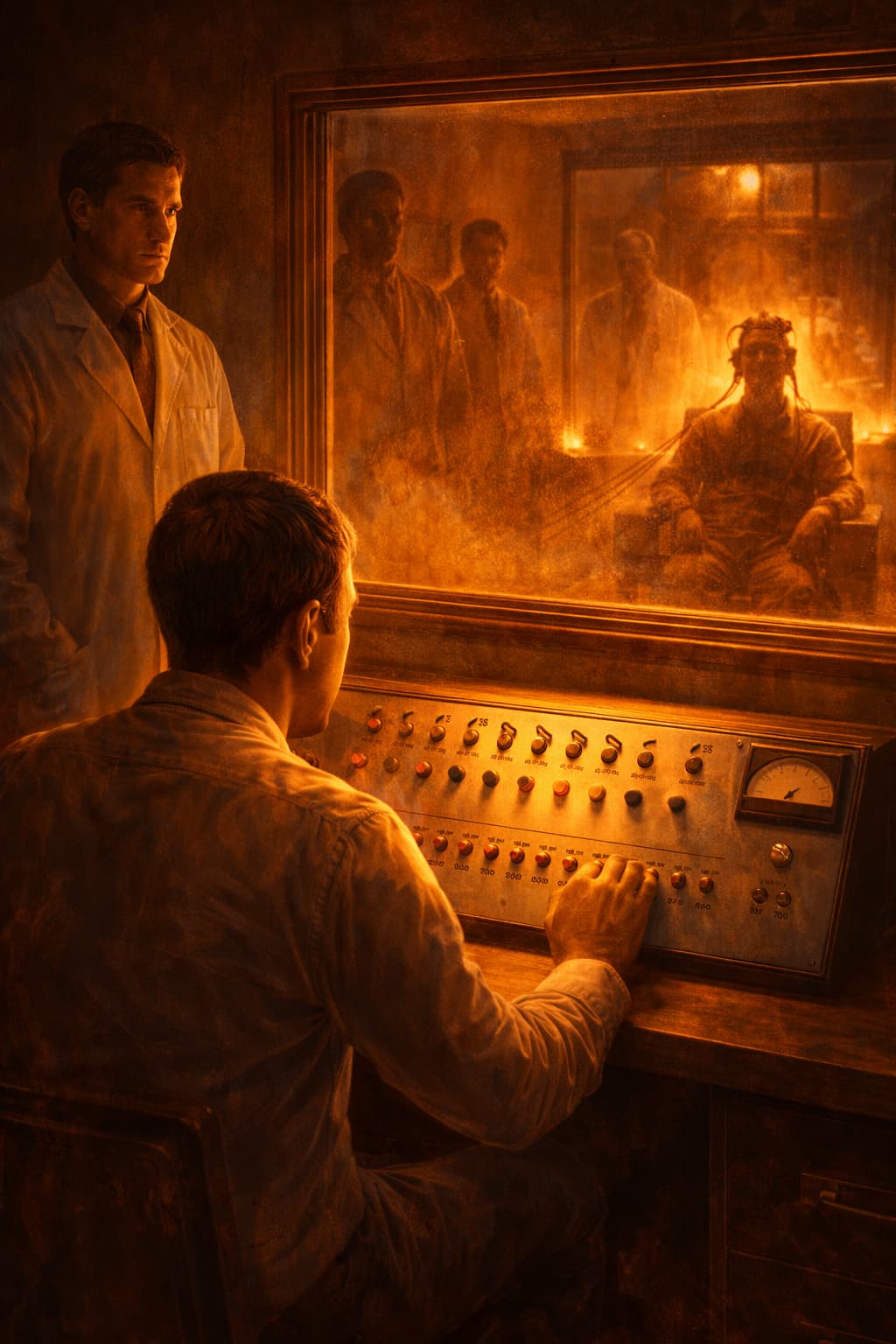
In the 1960s, psychologist Stanley Milgram conducted an experiment that became famous. He wanted to understand how far an ordinary individual will go when a legitimate authority asks him to obey.
The protocol is simple: participants believe they’re administering electric shocks to another person each time that person gives a wrong answer. In reality, the shocks are fake. But the participants don’t know that. Facing them, a scientist in a white coat tells them to continue, even when the person behind the glass seems to be suffering and begs for it to stop.
The results are disturbing. A majority of participants agree to deliver shocks they believe to be potentially lethal, simply because an authority tells them the experiment must go on.
They are neither sadistic nor stupid. They are ordinary people.
The experiment reveals something essential: when authority appears legitimate, moral sense can be set aside. Responsibility is transferred. You no longer act “in your own name”; you act “out of duty.”
This mechanism illuminates the entire history we’ve just walked through. Whether it’s a deified pharaoh, a medieval religious power, or a modern state, authority perceived as superior can disable individual discernment.
And when authority is further backed by fear, guilt, and group pressure, obedience becomes almost automatic.
The Era of Media and Invisible Conditioning
With the arrival of radio, television, and then 24/7 news, mass manipulation changes radically in scale. It no longer needs the grand spectacle of war posters or solemn speeches to impose itself. Now it penetrates the intimacy of homes, settles into daily life, and wears a familiar, almost friendly face. The message is no longer an exceptional event you can brace yourself for; it becomes a permanent atmosphere, a background noise that eventually saturates mental space.
When the same information, with the same words and the same emotions, is broadcast simultaneously to millions of people, it acquires the force of absolute authority. It seems indisputable not because of the veracity of the facts, but by sheer omnipresence. This is where modern propaganda achieves its masterstroke: it bets on familiarity, because what is familiar reassures, and what reassures is no longer questioned. Through repetition, lies end up becoming indisputable evidence, because the human mind eventually confuses the frequency of information with its credibility.
But this manipulation is even more subtle: it operates through selection and omission. You don’t only manipulate through direct lies, but also by choosing what deserves to be brought to light. What is shown becomes the only existing reality, while what is silenced disappears purely and simply from collective consciousness. Debate is thus framed within narrow limits; you’re allowed to discuss, but only within the framework defined by those who control the image. Certain fundamental questions become unthinkable, because they simply no longer have a place in the visual field. Gradually, manipulation becomes the very form of normality. And when normality is thus oriented, the majority ends up inhabiting a prison without bars, adhering unknowingly to a framework built from scratch to serve interests that are not their own.

Modern Techniques of Mass Manipulation
Contemporary mass manipulation no longer resembles the noisy parades or crude slogans of the last century. It has become an art of synthesis, an invisible form of engineering that never relies on a single mechanism but on a skillful combination of psychological levers. Its strength lies in its ability to adapt in real time, merging technology, behavioral psychology, and media saturation to create a web in which the mind ends up entangled.
The real danger doesn’t come from an isolated technique, but from their systematic interweaving. Fear is used to break your resistance, then guilt-tripping prevents you from backing down, all wrapped in a progressive normalization that makes you accept the unacceptable in small pieces. This constant mixture creates a state of confusion such that the individual ends up losing his own bearings. You no longer know whether you obey out of conviction, fear, or simple mental fatigue. By blurring the lines and mixing narratives, the system makes reality elusive. The goal isn’t only to make you believe a lie but also to exhaust you to the point where the search for truth becomes too heavy a burden to carry. For those who don’t know these inner workings, manipulation doesn’t look like an attack; it looks like reality.
It’s by dissecting these techniques one by one that you begin to see the puppet strings and can finally choose to break free.
Fear as the Primary Lever
Fear as the Primary Lever
This is the fastest tool to short-circuit intelligence. When a threat is waved incessantly, whether it’s the specter of a Third World War dangled before our eyes, climate catastrophes presented as imminent, or the shadow of a new pandemic brandished at the slightest opportunity, the brain instantly switches to survival mode. In this state of violent stress, the prefrontal cortex, seat of discernment and wisdom, fades in favor of the amygdala. A terrified population no longer asks for proof; it demands protection. Fear paralyzes reflection and pushes the masses to accept solutions they would have rejected with contempt in normal times, seeing authority as their only savior.
Moral Guilt-Tripping
Moral Guilt-Tripping
This lever transforms the social rule into a devouring inner obligation. The manipulation consists of making the citizen responsible for disasters orchestrated by others. We’re made to feel guilty about plastic pollution while industry imposed disposability by eliminating returnable glass without our consent. We’re taxed in the name of climate warming, accused of polluting with our cars while the real culprits exempt themselves from all constraints. This technique of training through shame is ancestral: in the Middle Ages, it was said that catastrophes were the punishment for the people’s sins. By making us guilty of the earth’s ills, we’re kept in a moral submission that prevents us from pointing out the true architects of these crises.
Control and Selection of Information
Control and Selection of Information
Manipulation does not always involve inventing lies; it can also mean filtering reality. By choosing which facts to spotlight and systematically concealing those that contradict the official narrative, a false sense of certainty is created. The public sphere is saturated with “experts” selected to validate the narrative, while dissenting analyses are silenced. This was starkly illustrated when the European Union imposed a form of social and financial death on Jacques Baud for providing factual and historical analysis of the war in Ukraine that did not align with the dominant media narrative. This mechanism turns information into a hall of mirrors in which any fact that might reveal what is happening behind the scenes is carefully excluded.
Disqualification by Labeling: Social Death
Disqualification by Labeling: Social Death
The word “conspiracy theorist” has become the new “heretic” of the 21st century. It’s a stigmatizing term to which other labels are now added, such as “far right” or “far left,” used to brand anyone who asks uncomfortable questions. This process makes it possible to avoid answering arguments by shifting the debate onto the morality or respectability of the person. Manipulation then uses the media to attempt to destroy reputations on a global scale through smear campaigns. This was seen with Professor Luc Montagnier, Nobel Prize in medicine, whom they tried to pass off as a senile old man to stifle his warnings, or with Professor Perronne, against whom a relentless campaign was waged before he was finally cleared by his peers; the medical board disciplinary chamber even confirmed his duty to speak out. This intellectual terrorism sends a clear message: anyone who steps out of line will have to endure unprecedented media and professional harassment to be silenced.
Pseudo-Expertise and Intellectual Intimidation
Pseudo-Expertise and Intellectual Intimidation
Power relies on television panels packed with “specialists” bearing impressive titles to paralyze any inclination to criticize. By using complex technical or medical jargon, they prevent ordinary common sense from speaking up: the message is clear—if you don’t speak their language, you have no right to have an opinion. This intimidation aims to make the individual doubt his own intelligence, pushing him to delegate his decision-making power to “competent authorities.” This was seen massively during recent crises where catastrophic mathematical modeling, presented as indisputable truths, served as a screen for arbitrary political decisions, preventing any substantive debate under the pretext of “scientific rigor.”
Progressive Normalization
Progressive Normalization
A brutal change would provoke immediate revolt. Modern manipulation therefore proceeds in infinitesimal steps: a restriction is introduced as “temporary” or “exceptional” to respond to an emergency. Once accepted, it becomes the foundation upon which the next measure is built. What was unthinkable yesterday becomes debatable today, acceptable tomorrow, and ordinary the day after. In Switzerland, the Covid Law is the perfect illustration: by passing liberty-restricting provisions after the crisis had ended, when the population was exhausted and used to restrictions, a control framework was perpetuated without anyone reacting. The temperature rises so slowly that the frog only realizes it’s cooked when it’s too late to jump.
The False Alternative
The False Alternative
This technique consists of locking the debate into a binary choice between two options presented as the only possible ones, systematically masking all other solutions. The public has the impression of exercising its free will while the framework of choice has been rigorously predefined by authority.
This was seen during the Covid crisis through the permanent blackmail: “Lockdown or mass death.” By deliberately erasing alternatives, such as early treatments or targeted reinforcement of care services, the population is forced to choose the lesser evil. It’s an intellectual trap that turns the citizen into a hostage of a rigged dilemma.
Cognitive Saturation
Cognitive Saturation
A constant flow of information, often contradictory and interspersed with futile content, ends up causing deep mental exhaustion. Through confusion, the brain loses its capacity for critical analysis and ends up accepting any simplistic narrative to regain a semblance of calm. This is what we experience daily on social networks: an incessant bombardment of notifications, “brainless” videos, and anxiety-inducing alerts that collide with each other. This organized chaos saturates attention, prevents any deep reflection, and pushes the individual toward apathy. You no longer know what to think, so you end up not thinking at all, giving free rein to those who steer the narrative.
Social Pressure and the Need for Belonging
Social Pressure and the Need for Belonging
The human being fears above all being excluded from his “tribe.” This fundamental need is used to force conformity, far beyond health issues. When the majority seems to adopt a position, deviating from it becomes socially costly: you risk mockery, judgment, or isolation. This is the mechanism observed with wearing masks outdoors, where many kept them simply out of fear of others’ gaze, even when it made no logical sense. By turning citizens into watchdogs over their neighbors, those in power rely on group pressure to secure a compliance that the law alone would not suffice to impose.
Victimization as a Manipulation Lever
Victimization as a Manipulation Lever
Being a victim of a real event is a reality. Manipulation occurs when an individual or group is encouraged to persistently identify with that role. On an individual scale, a person who has suffered trauma can be kept in a narrative of permanent powerlessness. On a collective scale, the memory of past wars or historical oppressions is used to define a people solely by its wound. This is notably seen when the memory of conflicts such as the Algerian War or the tensions in the Middle East is constantly revived by politicians to divide society or justify interference. By locking populations into resentment or the trauma of their ancestors, they’re prevented from building a sovereign future. The more identity is built around the wound, the more personal or collective power diminishes. If everything is suffered, nothing can be transformed. Victimization then becomes a powerful tool, because it creates a dependency on an authority expected to protect, repair, or make decisions.
Infantilization and Paternalistic Authority
Infantilization and Paternalistic Authority
Infantilization is not limited to simplifying discourse; it is a long-standing project aimed at stripping people of responsibility, and it continues to worsen. It establishes an authority that treats the population as though they were mentally deficient and incapable of the slightest independent thought. Its absurdity reached new heights with the requirement to sign one’s own permission slips to leave home, or with the proliferation of warning signs in public spaces for the most trivial situations, such as signs warning drivers about irrigation water on a country road.
This mechanism of constant “training” is designed to make individuals give up their own perception of reality in favor of following instructions. The result today is dramatic: a large part of the population has lost its instinct for discernment. People can no longer distinguish truth from lies, even in the face of absolute horrors like the Epstein affair, because their capacity for indignation and reflection has been anesthetized by decades of tutelage. This passivity shows that infantilization has achieved its goal: turning citizens into passive subjects who no longer know how to think for themselves, leaving elites free to act without resistance.
It’s in this sense that infantilization is the most dangerous of all manipulation techniques: it not only steals the freedom to act but also destroys the capacity to understand that one has it. When fear can still provoke anger, when guilt can still awaken conscience, infantilization, for its part, anesthetizes even the reflex to revolt. It’s the mother technique, the one that makes all others possible and undetectable.
The Slide Towards an Authoritarian System
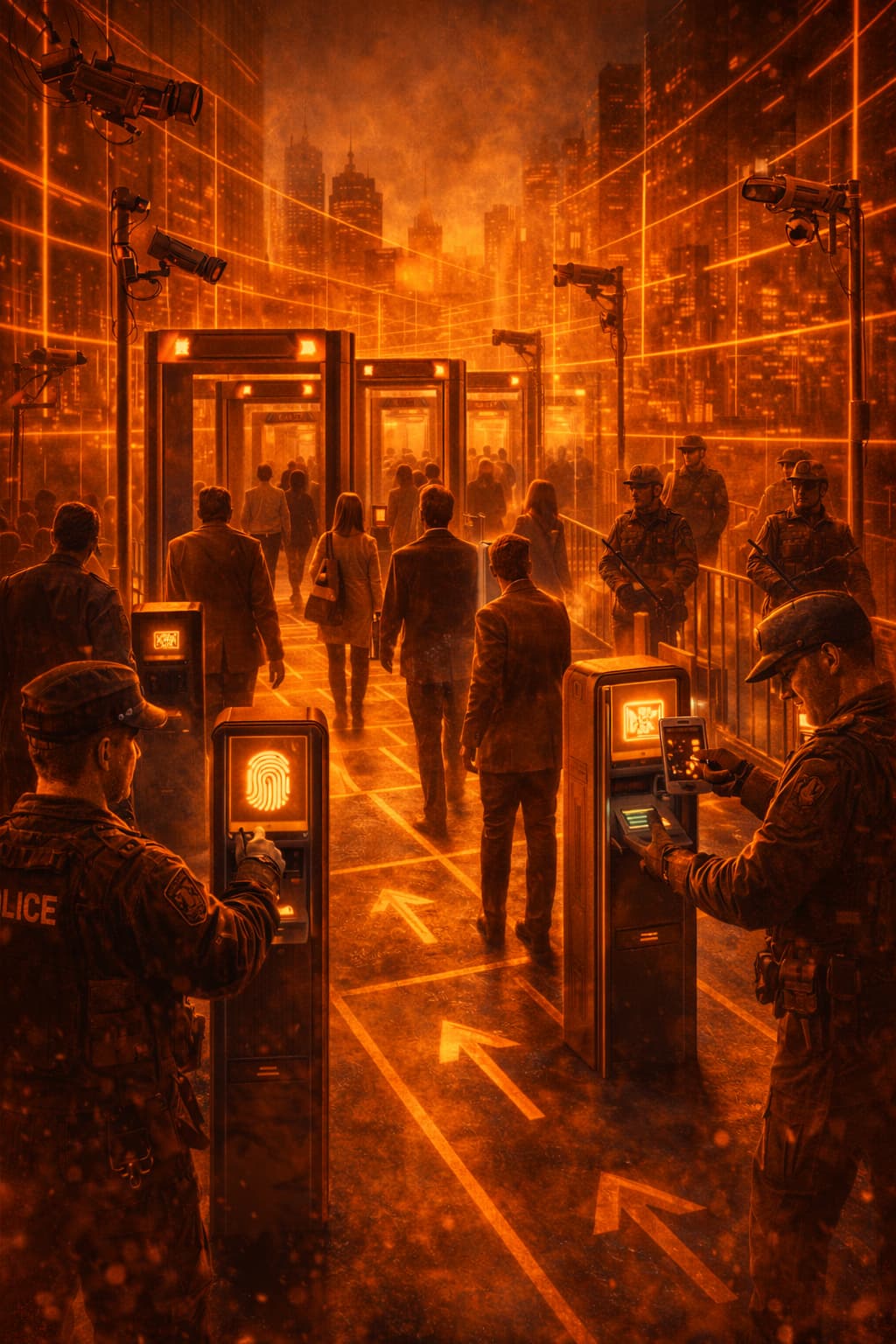
When these mechanisms combine—permanent fear, guilt-tripping, sustained victimization, authoritarian infantilization, and control of information—they don’t immediately create a totalitarian regime. But they prepare the ground.
A society doesn’t tip over in a day. It gets used to it. Restrictions are first presented as temporary. Control measures are justified by protection. Surveillance devices appear reasonable in an emergency context. Each step seems isolated, justified, and proportionate. It’s the accumulation that changes the nature of the system.
The more infantilization progresses, the more the population accepts that decisions are made for it. The more fear is maintained, the more the demand for protection increases. The more guilt is activated, the more dissent becomes morally suspect. The more information is framed, the narrower the field of debate becomes.
Totalitarianism doesn’t begin with brutality. It begins when control becomes normal, when surveillance seems logical, when the reduction of freedom is perceived as necessary.
And it’s precisely because this shift is gradual that it’s hard to notice in real time. Some resist, others adapt, many get used to it. History shows that it’s rarely sudden ruptures that transform a society, but successive slides accepted in the name of the common good.
Breaking the Hypnosis
The diagnosis is clear, but it’s not inevitable. Understanding the strings of manipulation is the first step to no longer being a puppet. Sovereignty is not negotiated with those who seek to take it from us: it’s reclaimed, here and now, in our minds and in our actions.
The time has come to move from diagnosis to liberation. Let us not remain alone facing this machinery. There are concrete ways to reactivate our discernment, to stop waiting for a savior, and to take back the reins of our existence.
What you have just read describes the cage. The next page opens the door.
Sources and references for this page (click to expand)
- Propaganda – How to manipulate… – Edward L. Bernays
- Milgram experiment – Académie de Normandie
- How Jacques Baud Is Experiencing the Social Death Imposed by the EU, by Thibault de Varenne
- Professor Perronne Cleared by the Île-de-France Disciplinary Chamber of the French Medical Council
- Luc Montagnier