
We are seeing more and more people experience persistent fatigue despite rest, morning stiffness that takes time to ease, a sensation of cold in the extremities without obvious cause, or mental fog that appears at times without a clear explanation. Taken individually, these signals seem minor. But when they persist over time and occur together, they form a pattern that medicine still struggles to connect as a whole. Something is gradually and silently going off balance.
In this context, one protein remains largely underestimated even though it plays a central role in these symptoms. It is fibrin.
Fibrin, a vital mechanism in a balanced body
Fibrin is not a problem in itself. It is essential to life. When an injury occurs, the body triggers a precise cascade of reactions to stop the bleeding.
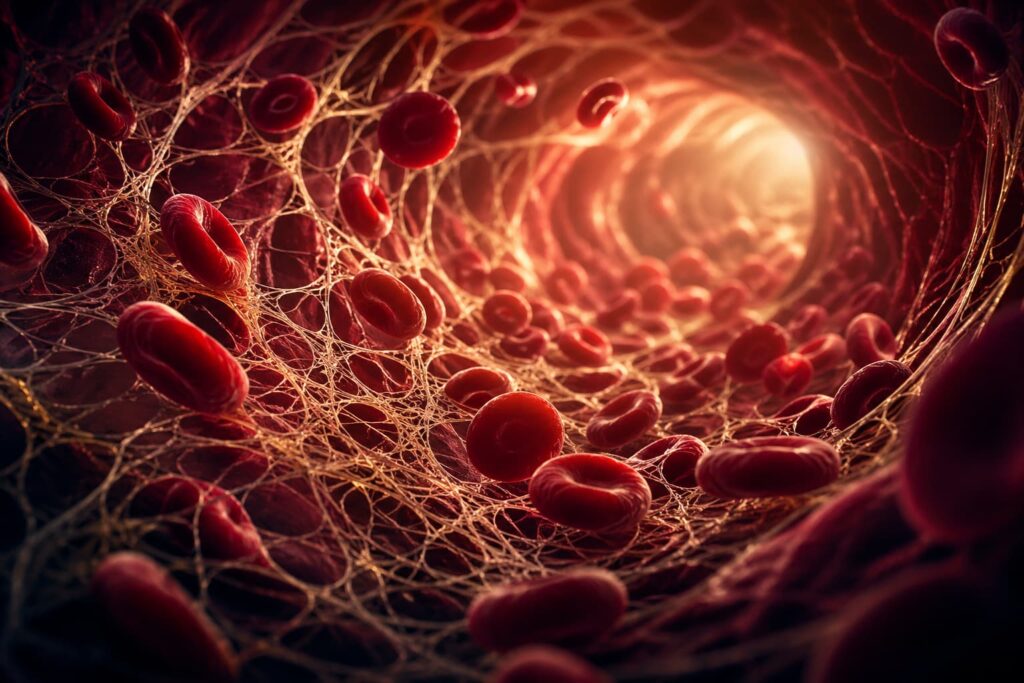
Fibrin acts as a protective structure by forming a mesh that stabilizes the clot and allows tissue repair. This process is temporary and tightly regulated in a healthy body. Once repair is complete, the body naturally dissolves the now-unnecessary fibrin.
The cycle is smooth, clean, and controlled. The problem arises when this cycle no longer closes properly.
A body kept in a permanent state of alert
We now live in an environment where the body is constantly stimulated as if it had to repair itself nonstop. This is not necessarily from a visible injury but from an accumulation of internal signals that sustain a state of chronic alert.
A diet perceived as healthy but high in carbohydrates, repeated use of unstable vegetable oils such as canola or sunflower, constant blood-sugar fluctuations, prolonged stress, and certain persistent infections create a low-grade but ongoing inflammatory environment.
Faced with this, the body adapts. It produces fibrin repeatedly, as if it must repair continuously. At the same time, the mechanisms responsible for breaking it down become insufficient.
Gradually, an imbalance sets in. This buildup is not always recognized as a distinct pathology, but it corresponds to a well-documented state in the scientific literature: subclinical hypercoagulation associated with low-grade inflammation.
We are not dealing with an overt disease. We are dealing with a gradually deteriorating terrain.
The impact of excess fibrin on the body
When fibrin accumulates, it does not remain neutral. It gradually deposits in tissues and along the finest vascular walls. Circulation becomes less fluid, exchanges slow down, and oxygen and nutrients reach cells less effectively. In this context, energy production declines, not suddenly, but steadily and diffusely.
The body becomes stiffer. Connective tissues lose elasticity, fasciae thicken, and joints move less freely. This stiffness is not only mechanical; it is also circulatory.
The brain itself can be affected. Impaired microcirculation is enough to disrupt mental clarity, concentration, and the flow of thoughts. What we feel is not always dramatic, but it reflects a deep, ongoing wear.
Signals the body sends
Over time, certain signs become recurrent and increasingly appear together in different people: fatigue that does not truly improve with rest, persistent morning stiffness, cold hands and feet, slower wound healing, leg heaviness, unusual shortness of breath, difficulty staying focused, diffuse pain, or burning sensations in the extremities. None of these signals alone is enough to draw a conclusion. But their combination, in the current context, deserves a broader reading.
More and more people are experiencing these symptoms, and their frequency is rising with the years.
An observation from the field
This observation is not based solely on theoretical data. It also comes from lived experience. Some issues can improve significantly with an adapted diet, particularly by reducing carbohydrate load and associated inflammation.
Yet part of the symptoms sometimes persists. It is often by exploring less visible mechanisms, such as fibrin and its regulation, that new avenues appear. This observational work is ongoing and will be pursued in a structured way.
Understanding to regain a coherent reading of the body
Fibrin is not limited to acute situations or medical emergencies. It fits into a much broader dynamic linked to the body’s overall inflammatory state. In an environment where this state is becoming common, understanding these mechanisms helps connect symptoms that previously seemed isolated.
Returning to this understanding is already a way to restore coherence. And it is from this coherence that relevant solutions can emerge.
Warning
This content is provided for informational and educational purposes only. It does not replace medical advice, diagnosis, or treatment. The information presented aims to offer a global understanding of the body’s mechanisms but does not substitute for care by a qualified health professional. If you have symptoms or concerns, appropriate medical support remains necessary.
Sources and References
- Fibrin clot properties in cardiovascular disease: from basic mechanisms to clinical practice
- Chronic fatigue syndrome and/or fibromyalgia as a variation of antiphospholipid antibody syndrome: an explanatory model and approach to laboratory diagnosis
- The Occurrence of Hyperactivated Platelets and Fibrinaloid Microclots in Myalgic Encephalomyelitis/Chronic Fatigue Syndrome (ME/CFS)