
You’re told that whole grains are healthy. That whole wheat bread, oatmeal, or brown rice are pillars of a balanced diet. That if you have digestive issues, it’s because you’re sensitive, or because modern grains are too refined.
But what if the problem isn’t your sensitivity or the refinement? What if the problem lies within the grains themselves, and has been there since the dawn of agriculture? Around 10,000 years ago, humanity underwent a significant shift.
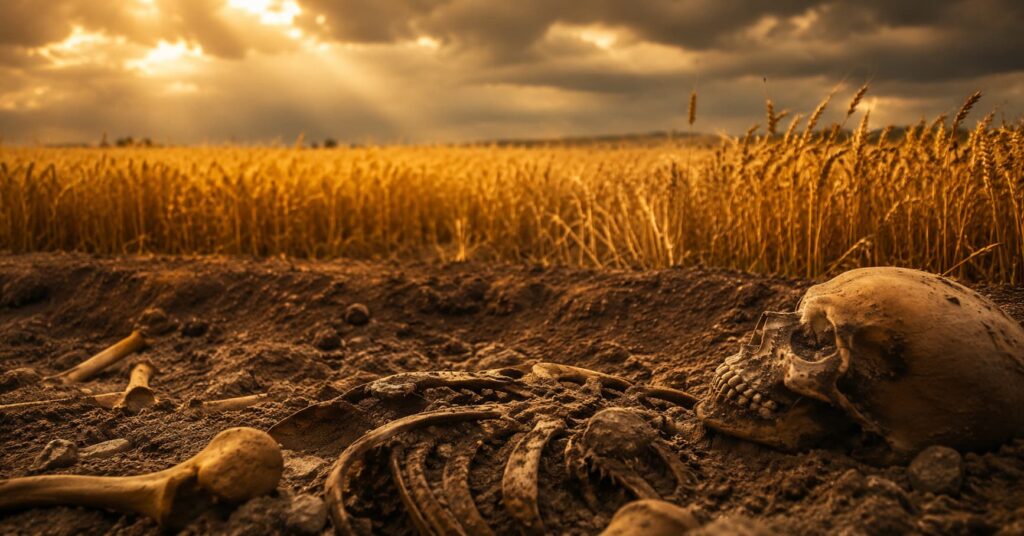
It transitioned from a nomadic lifestyle based on hunting, gathering, and a diverse diet, to settling around grain cultivation. This shift, often portrayed as a civilizational advancement, left a measurable mark on our bones. Neolithic skeletons tell a story that no one wanted to read: that of a human body that weakened, shrank, and became deficient precisely when it began cultivating its food.
When the Body Shrinks
Paleolithic hunter-gatherers were on average more than 10 cm taller than the first Neolithic farmers, both men and women. This decrease in stature is not trivial; it indicates chronic malnutrition. The diet became impoverished in quality proteins, fat-soluble vitamins, and bioavailable minerals.
In their place: grains. Lots of grains. Every day.
As the dietary base. The grain provided quantity but starved in quality. The body faced a carbohydrate-heavy monodiet, lacking what it needed to build bones, muscles, and tissues.
Unlike hunting or gathering, harvests depended on climate, pests, and other uncertainties. Famines became chronic. Skeletons bear the scars of these growth interruptions: visible lines on tooth enamel, known as enamel hypoplasia. The body recorded each period of scarcity.
Teeth That Decay
Hunter-gatherers had surprisingly healthy teeth. Few cavities, abscesses, or pathological wear. With the Neolithic era, everything changed.
Cavities skyrocketed. Abscesses became common. Dental infections, sources of systemic inflammation, multiplied.
Why? Because fermentable carbohydrates from grains stick to teeth, feed pathogenic bacteria, and chronically acidify the mouth. It’s not a hygiene problem.
It’s a substrate problem. Hunter-gatherers ate meat, fish, roots, and berries. Their mouths were not conducive to cavities.
Farmers ate ground, cooked, sticky grains. Their mouths became incubators.
Anemia Inscribed in Bones
Neolithic skulls frequently show porous lesions around the eye sockets and cranial vault. This is known as cribra orbitalia. It’s the skeletal signature of severe, chronic anemia that lasted for years.
An iron deficiency anemia. Yet these populations cultivated and stored food. They had access to food in quantity.
So why the deficiency? Because grains contain phytates. These molecules bind to iron, zinc, calcium, and magnesium in the intestine and prevent their absorption.
You can consume iron, but if phytates are present in excess, your body won’t absorb it. Humans became deficient amidst their fields. Phytates are not a modern problem.
They are intrinsic to grains. Whole or refined, organic or conventional, ancient or modern: phytates are there. And they block the absorption of essential minerals.
It’s not a question of industrial processing. It’s a question of plant biology.
A Body Worn Out by Labor
Early osteoarthritis surged in the Neolithic era. Deformations of the spine, knees, and toes became common. Among women, in particular, deformations related to kneeling to grind grain for hours on end, day after day, were observed.
The body wore itself out producing what made it sick. But it’s not just the physical labor. It’s also the metabolic terrain.
Grains provide a massive, chronic, cumulative carbohydrate load. They keep insulin elevated permanently. They create an underlying inflammatory terrain.
And chronic inflammation, even low-grade, accelerates joint degradation, bone density loss, and tissue aging. Hunter-gatherers aged differently. Their joints held up.
Their bones remained dense. Their bodies did not carry this constant inflammatory burden. What modern biology allows us to understand today is the mechanism behind what the bones were already recording.
Diseases That Didn’t Exist
Settling to store grain created a new closeness: with livestock, with rodents attracted by silos, with parasites. Major infectious diseases were born there. Tuberculosis, smallpox, influenza, plague.
These mass epidemics were unknown to nomadic hunter-gatherers, because their nomadic lifestyle and diverse diet did not create the conditions for their spread. They appeared with agriculture. And the immune system, weakened by cereal malnutrition, iron and zinc deficiencies, and chronic inflammation from the carbohydrate load, faced epidemics for which it was unprepared. Skeletons bear the traces of these recurrent infections: bone lesions, deformations, growth arrests.
What This Means for You Today
Modern grains are problematic not only because of pesticides, glyphosate, or genetic modifications. They are also problematic because of what they’ve always been: seeds rich in antinutrients (lectins, phytates, pro-inflammatory ATIs) and carbohydrates that keep insulin chronically high. The “whole” or “organic” label doesn’t change this biological reality.
Phytates are even more concentrated in whole grains. Lectins cross the intestinal barrier and trigger inflammatory responses. ATIs (amylase-trypsin inhibitors) activate the innate immune system, even in the absence of celiac disease.
And the cumulative carbohydrate load, whether from whole wheat bread, oatmeal, brown rice, or semi-whole pasta, creates the same dysregulated metabolic terrain: high insulin, low-grade inflammation, difficulty mobilizing fats, chronic fatigue, brain fog. Neolithic skeletons don’t lie. They show what happens to a human body when it bases its diet on grains.
Smaller, more deficient, sicker, more fragile. This is not a hypothesis. It’s a documented, convergent, measurable anthropological observation.
You don’t have to repeat this mistake. Your body doesn’t need grains to function.
It knows how to produce the glucose it needs from proteins and fats, provided it is given real ones: complete, bioavailable animal proteins that no plant source matches in quality, and stable animal fats rich in fat-soluble vitamins that the body recognizes and uses.
What the body can’t do indefinitely is compensate for deficiencies created by antinutrients and repair the damage of chronic inflammation maintained by excessive carbohydrate load. But what it can do, and what research increasingly documents, is regenerate when the terrain changes. Inflammation recedes.
Deficiencies correct themselves. Energy returns. The body doesn’t forget what it has always known how to do.
It just waits for the right conditions. Listening to what the skeletons tell us is choosing to return to what your body has always known how to do, which has never stopped compensating, correcting, adapting to what was imposed on it, at the cost of its exhaustion.
DISCLAIMER: This article is for informational purposes only and does not replace personalized medical advice. The dietary choices described here are based on documented anthropological and biological data, but any change to your diet, especially in the presence of medical conditions or ongoing treatment, should be discussed with a qualified healthcare professional.
Sources and References
-
Cohen, M. N. — & Armelagos, G. J. (Eds.). (1984). Paleopathology at the Origins of Agriculture. Academic Press.
-
Larsen, C. S. (1995). Biological Changes in Human Populations with Agriculture. Annual Review of Anthropology, 24, 185-213.
-
Price, W. A. (1939). Nutrition and Physical Degeneration: A Comparison of Primitive and Modern Diets and Their Effects. Paul B. Hoeber / Price-Pottenger Nutrition Foundation.
-
Cordain, L. (1999). Cereal grains: humanity's double-edged sword. World Review of Nutrition and Dietetics, 84, 19-73.
-
Lindeberg, S. (2010). Food and Western Disease: Health and Nutrition from an Evolutionary Perspective. Wiley-Blackwell.