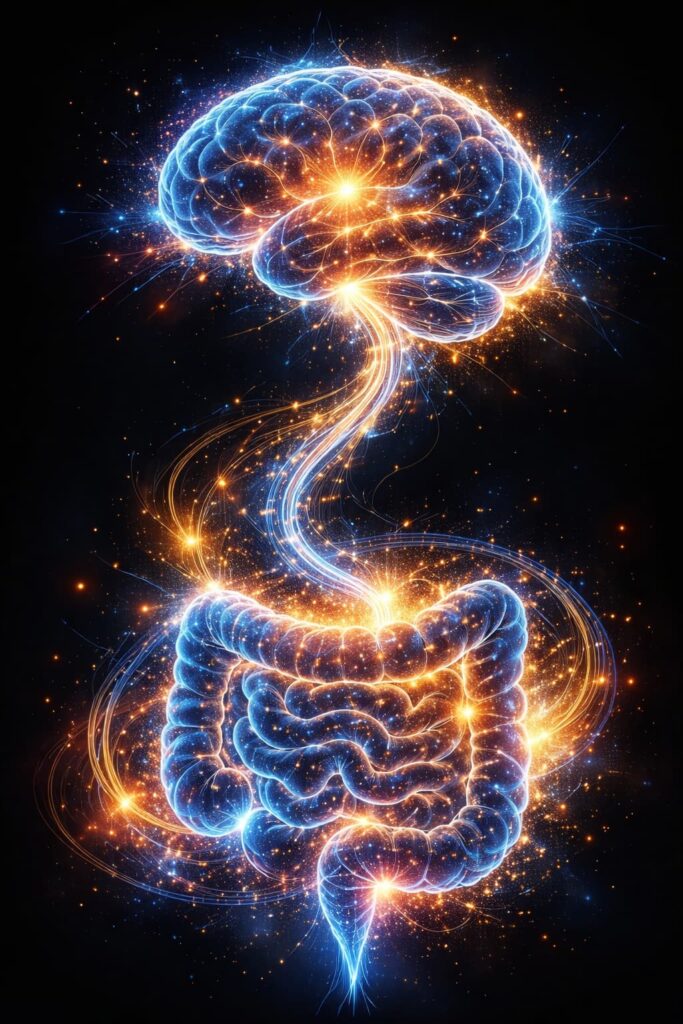
We were long taught that our emotions and mental clarity depended solely on the chemistry of our brain. Yet modern science is now highlighting a far more influential player: the gut-brain axis.
This fascinating biological connection reveals that our mental health takes root far beyond our skull, right in the heart of our metabolism. By understanding how these two organs communicate, particularly via the vagus nerve, we reclaim power over our inner balance.
Insulin: The Conductor of Brain Energy
This is where the pioneering work of neurologist David Perlmutter truly comes into its own. Long before metabolic psychiatry became a cutting-edge topic, he was already warning about the devastating impact of carbohydrates and insulin on our neurons. To understand the gut-brain axis, we must first understand how our fuel is managed. When we develop resistance to insulin (a crucial topic I explain in detail on my dedicated page), our brain loses its ability to use glucose efficiently.
We then find ourselves in a paradoxical situation: the blood is saturated with sugar, but the neurons are “starving” because energy can no longer enter. This lack of cellular energy is often the first trigger for brain fog and mood disorders.
The Clinical Case of Doris: The End of a Fifty-Year Ordeal
To grasp the scope of these discoveries, we need to look at concrete results. One example that has become famous in medical literature, and is often cited by experts like Dr. David Perlmutter, is that of Doris. Diagnosed with schizophrenia at age 17, Doris spent over fifty years in the fog of the illness and heavy treatments.
It wasn’t until she was 70, by radically changing her metabolism through a ketogenic diet , that she experienced a biological miracle: her hallucinations disappeared, and she was able to stop all her medications. This case, documented by Dr.
Westman and later taken up by Harvard psychiatrist Christopher Palmer, proves that the brain possesses an unsuspected capacity for healing when the metabolic root cause is finally addressed.
The Vagus Nerve: The Mastermind of the Gut-Brain Axis
To understand why diet can reverse severe pathologies, we need to focus on the mechanics of the gut-brain axis. The pivot of this communication is the vagus nerve, the longest nerve of the autonomic nervous system.
For a long time, it was believed to serve only digestion, but modern science has revealed that 80% of its fibers are “afferent”: they carry information from the gut up to the brain.
This is where the work of Dr. Georgia Ede becomes fundamental.
She demonstrates that the brain is a “metabolic victim. ” When our diet is saturated with processed products and carbohydrates , it creates inflammation of the intestinal wall (permeability).
The vagus nerve then captures immune distress signals and toxins, which it transports directly to the emotion centers of the brain. This is not just a “bad mood”; it’s a biological hijacking. If the vagus nerve transmits a message of chronic inflammation , the brain switches into survival mode.
It is this corrupted signal that fuels the generalized anxiety and depressive episodes that classical psychiatry tries to mask with chemical molecules, without ever extinguishing the fire at its source.
Why Metabolic Psychiatry Changes Everything
This is where the work of Georgia Ede and Christopher Palmer converges to form a new discipline. They don’t just say that “eating healthy is good for your mood. ” They prove that mental disorders are mitochondrial pathologies.
Each of our cells contains tiny energy factories: the mitochondria. When the gut-brain axis is saturated by inflammation and insulin resistance, these factories break down.
A neuron whose mitochondria are no longer functioning cannot properly regulate neurotransmitters like dopamine or serotonin. As Palmer highlights in his research, depression or bipolar disorder are often just the visible manifestations of a brain experiencing a biological power outage. By changing your diet, you’re not just “going on a diet”; you’re restoring the electrical grid of your mind.
The Intestinal Factory of Neurotransmitters
It’s time to bust a myth: our brain is not the sole producer of our mental chemistry. In reality, the gut and gut microbiota help shape our mental chemistry : not the brain alone.
It is now estimated that about 95% of serotonin (the molecule of serenity) is produced in the gut. For dopamine (motivation and reward), the gut microbiota is not a major intestinal producer: it influences brain production through indirect pathways, including inflammation, microbial metabolites, and signaling via the vagus nerve.
But beware, this production depends entirely on the state of your biology. If your intestines are inflamed or if your gut microbiota is unbalanced by a diet high in sugars and processed products, the factory shuts down or malfunctions.
Instead of converting amino acids (like tryptophan) into serotonin to calm you, a struggling intestine diverts them to produce quinolinic acid, a neurotoxin that promotes anxiety and depression.
The gut-brain axis is not just a communication line; it’s a chemical production chain. If the foundation is corrupted, the top (your brain) cannot function correctly, no matter how many medications you take.
The Journey of Molecules and the Hijacking of the Signal
One might think that the serotonin produced in the gut simply takes an “elevator” up to the brain. In reality, it’s much more subtle and fascinating.
Intestinal serotonin does not directly cross the blood-brain barrier (the security checkpoint at the brain’s entrance). So how does it influence our mood?
This is where the vagus nerve steps in again as a high-tech sensor. The cells of your intestine “present” the neurotransmitters to the endings of the vagus nerve. This nerve then transforms the chemical information into an electrical signal that travels instantly up to the brainstem.
But there is a second, darker journey that Dr. Georgia Ede highlights: that of the precursors. To manufacture serotonin, your brain needs an amino acid called tryptophan.
- In a healthy body: Tryptophan travels peacefully to the brain to become the molecule of happiness.
- In an inflamed body (disrupted gut-brain axis): Inflammation diverts this journey. Tryptophan is “stolen” by a metabolic pathway called the kynurenine pathway. Instead of producing serotonin, your body produces toxic substances that “fry” your neurons and create anxiety. You literally have a brain on fire because your intestinal logistics have been hijacked by inflammation.
The Clinical Evidence from Georgia Ede on Hospitalized Patients
For those who still doubt the power of nutrition on severe pathologies, the work of Dr. Georgia Ede provides definitive answers.
She has conducted and published fascinating studies on hospitalized patients suffering from major depression, bipolar disorder, or psychosis who no longer responded to any standard medication. In one of her most striking protocols, she placed these patients on a strictly controlled therapeutic ketogenic diet.
The results shook the certainties of modern psychiatry: 100% of patients saw their metabolic health markers improve, and nearly half entered full clinical remission. People who were considered “lost” to society regained mental clarity and emotional stability within weeks.
These studies prove that when you stop assaulting the gut and restore metabolism, the brain regains its ability to regulate itself. This is no longer a hypothesis; it is a documented medical reality.
Georgia Ede’s Precision Mechanics: Elimination for Repair
What Georgia Ede explains with formidable clarity is that our brain is the most protected organ in the body, but also the most fragile when faced with metabolic attacks. In her nutritional psychiatry protocols, she doesn’t just add “good nutrients. ” She insists on the elimination of anti-nutrients and inflammatory toxins that scramble the signal of the gut-brain axis.
She has demonstrated that for patients with bipolar disorder or schizophrenia, simply eliminating processed vegetable oils, sugars, and sometimes certain inflammatory plant proteins (like gluten) allows the vagus nerve to stop sending panic signals.
By cleaning up the intestinal terrain, neurotransmitters can finally resume their journey and their original function: stabilizing mood and clarifying thought. As Dr. Ede often says, the brain doesn’t need to be “drugged” to get better; it needs us to stop starving and assaulting it.
Reclaiming Your Biological Sovereignty
Understanding the gut-brain axis is realizing that mental health is not a psychological fate, but the result of a precise biological balance. Every time you choose a whole food over a processed product, you reclaim a part of your autonomy. True sovereignty begins on the plate: it is the most concrete act of resistance against industrial dependency.
By choosing to properly nourish your mitochondria and respect your entire biology, you stop being a victim of your own chemistry. Brain fog or chronic anxiety are no longer endured as life sentences.
Sovereignty is that moment when you realize that the individual is the base of the pyramid. If you decide to relearn how to eat healthily, the entire system built on managing illness loses its grip.
Choosing Life Over Chemical Survival
Relearning to make the effort to eat properly is not a constraint; it is the ultimate investment to preserve your freedom to be, in all the beauty of that term’s true meaning. Breaking free from dependence on the products of the agri-food industry is the only path to lasting vitality. You are never better off than when you take back control of your overall biology.
The message is clear: when consumption choices change, the balance of power shifts. Power lies in understanding these mechanisms.
Restoring the gut-brain axis is giving yourself the keys to your own autonomy and ensuring that no more lives are wasted simply due to ignorance of one’s own alchemy. That is the whole challenge of a conscious and sovereign approach to health.
To Go Further
If these truths resonate with you, if you feel that your body and mind are calling to break free from this numbness to reclaim their full power, then you have a place among us.
We are all alchemists. The transmutation of your health is the first step toward your global sovereignty. Don’t face the system alone: join the SLAKE community. We look forward to welcoming you to build this new paradigm of freedom together.
👉 To join us: Go to the homepage of SLAKEVITAL.COM and sign up.
The awakening begins here. Become the alchemist of your own life.
DISCLAIMER: This article is for informational purposes only and does not replace personalized medical advice. The information presented aims to clarify documented biological mechanisms; any decision about your health, especially with medical conditions, ongoing treatment, or scheduled surgery, should be discussed with a qualified healthcare professional.
Sources and References
-
The ketogenic diet and remission of psychotic symptoms in schizophrenia: Two case studies
-
The kynurenine pathway and the brain: Challenges, controversies and promises
-
Gut Bacteria and Neurotransmitters
-
The Ketogenic Diet for Refractory Mental Illness: A Retrospective Analysis of 31 Inpatients
-
drperlmutter com