
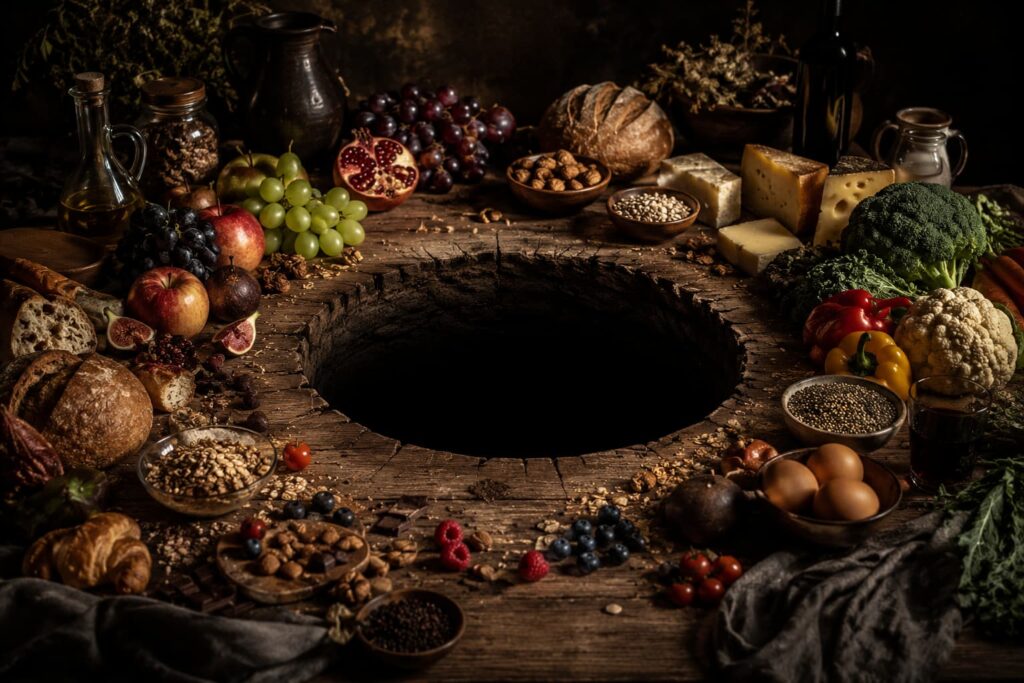
Many of us find ourselves in this situation: reaching for the cupboard just after finishing a meal, inspecting the fridge without really knowing what we’re looking for, or feeling a craving that sweeps through the body without any real hunger present. Shame often accompanies this action. We wonder why we can’t control what seems so simple for others.
But what many don’t realize is that it’s not a failure of willpower. It’s the trace of a body that has learned to survive. A body that has compensated, protected, sought comfort, energy, calm, or sometimes just a moment of relief through food.
It’s not a weakness. It’s a fidelity, in the most biological sense: the body remains faithful to what it has learned to keep standing. The body doesn’t operate on willpower.
It operates with chemical messengers, biological cycles, and needs that go far beyond the stomach. When these systems become confused, the relationship with food changes without us understanding why. Some people seek food.
Others seek comfort. And sometimes, without knowing it, we use food to try to fill a void that was never hungry. What follows is not a lesson on hormones.
It’s a series of situations that many recognize, and for each, a way to understand what might be happening in the body. Not to judge oneself, but to recognize what has been built, often over many years, and deserves to be heard.
“I’m Hungry Two Hours After Eating”
The meal just ended. The plate was full, nothing was skipped. Yet, two hours later, hunger returns with an insistence that doesn’t seem like a mere craving.
The stomach growls, the head feels slightly empty, hands may tremble. This rapid hunger doesn’t match the normal digestion time. When the body demands food so soon after a meal, it’s often a sign that something went wrong in energy management.
Insulin spikes too quickly, too strongly, then drops, taking blood sugar with it. What’s left after this drop is an intense feeling of hunger even though the body has just received calories. The meal might have contained a high carbohydrate load, whether from bread, pasta, rice, fruits, or juices, and lacked fats or proteins to stabilize this rise.
Result: a spike followed by a drop, and the body asks for food again to recover. This loop doesn’t come from a failing stomach. It comes from a metabolic signal that no longer regulates correctly.
Looking at what really composed the plate can sometimes help understand this rebound, not to correct oneself immediately, but to hear what the body just experienced.
“I Open the Fridge but Nothing Appeals to Me”
Standing in front of the open fridge, scanning the shelves without knowing what you’re looking for. Nothing really appeals. You close it, come back ten minutes later, and repeat.
This repeated action often translates to a need that food can’t fulfill. The body might be seeking comfort, stimulation, a break in a too-tense day. The brain’s reward circuits, which release dopamine when we eat something pleasing, can activate even in the absence of real hunger.
We open the fridge because we unconsciously hope that something in there will bring relief. But when nothing satisfies, it’s often because what we’re seeking isn’t food. Sometimes, it’s a moment of calm.
Sometimes, it’s a distraction from an emotion we don’t want to feel. Before closing the door once more, a pause is enough: what need are we really trying to fulfill with this action?
“I Only Think About Eating in the Evening”
The day went normally. Meals were taken, perhaps even with discipline. But as soon as evening comes, something shifts.
Thoughts revolve around food, the craving becomes obsessive, and what was supposed to be a simple dinner turns into endless snacking. Several mechanisms can converge here. If the day’s meals were too light, too low in fats or proteins, the body reaches the end of the day with a real energy deficit.
Furthermore, leptin, an adiposity messenger produced by fat tissue to inform the hypothalamus of the state of reserves over time, may no longer be heard correctly when leptin resistance sets in, often linked to chronically elevated insulin. The brain then believes it lacks reserves even though the body has them, and hunger persists in the evening like a poorly calibrated alert.
Cortisol, the stress hormone that follows a natural cycle, rises in the morning to wake us up, then gradually decreases throughout the day. When this rhythm is disrupted by underlying stress, the kind that settles over time and not just on a difficult day, cortisol can remain elevated in the evening, and with it comes an activation that drives us to seek comfort in food. The evening often reveals what the day silently demanded from the body: a real deficit, a tense nervous terrain, fragile nights accumulating over time.
“I Eat but Never Feel Satisfied”
The meal is over, the plate is empty, but the feeling of satiety never comes. You could keep eating without difficulty, as if the body received nothing. This absence of a stop signal doesn’t come from a lack of control.
It comes from a broken dialogue between the gut, the brain, and the metabolic terrain. Acute satiety signals (CCK, PYY, GLP-1, gastric distension) indicate during the meal that it’s time to stop. When they are weak or delayed, the “enough” doesn’t arrive during the meal, even if the calories are there.
Leptin isn’t that messenger. It’s a long-term adiposity signal: the more fat reserves there are, the more it circulates, to inform the brain of the stock status over time. When leptin resistance sets in, the brain interprets an abundance of reserves as a shortage and maintains chronic hunger, even after a meal that should have sufficed.
This resistance builds gradually, often linked to chronic exposure to high insulin and repeated carbohydrate load over time. Nutritional density also plays a role. A meal can be caloric without truly nourishing the cells.
If the plate mainly provides a high carbohydrate load, with little quality protein, few stable fats, and few essential nutrients, the body remains in demand even after eating. It seeks what it lacks, and as long as it doesn’t find it, the hunger signal persists. What the plate lacks (stable proteins, quality fats, real density) sometimes reveals why the body continues to demand, beyond mere willpower.
“I Eat Enough but Something Remains Unsatisfied”
The quantities are there. Meals are taken. Yet, dissatisfaction remains, a void that food doesn’t really fill.
Sometimes, this void comes from an unrecognized emotional need. Food then becomes a substitute for what’s missing elsewhere: connection, rest, meaning, joy. We eat to fill an inner space that daily life has hollowed out, but this filling remains temporary because it’s not food that we need.
Other times, it’s the body itself that remains alert despite caloric intake. A chronic inflammatory terrain, a gut that poorly absorbs nutrients, or a nervous system formed in insecurity and maintained in survival mode can maintain a sense of lack even when energy needs seem covered. The body doesn’t feel safe, and as long as it isn’t, it continues to seek.
This void can’t be filled with food. It questions something else, deep rest, connection, the inner security that the body is still trying to find, sometimes for a very long time.
“I Eat Mainly When I’m Stressed, Tense, or Exhausted”
Food becomes a refuge when the body no longer knows how to manage what it’s going through. Stress, tension, exhaustion: these states activate cortisol, and with it comes an instinctive search for comfort. Eating provides immediate relief because it activates the reward circuits, those that release dopamine and create a temporary feeling of relaxation.
But this relief doesn’t last. The stress remains, the tension returns, and the body asks for that action that worked the previous time. This loop can become automatic: as soon as a difficult emotion appears, the hand reaches for food before we’re even aware of what’s happening.
Chronically elevated cortisol also disrupts other messengers. It interferes with insulin, promotes fat storage, and keeps the body in an alert state that prevents true satiety. Eating under stress doesn’t nourish the same way as eating in calm.
The body remains in survival mode, and as long as it is, it seeks to protect itself by accumulating. Feeling the difference between hunger and tension already there: two languages the body mixes when it has long lacked relaxation.
“I Eat to Fall Asleep or to Calm Myself”
Eating before sleeping, or eating to soothe inner agitation, is not a coincidence. Many people, in the evening, don’t seek sugar: they go for proteins and fats (eggs, meat, cheese), as if the body instinctively knew what fuel it lacks to get through the night. The most useful framework here is glycemic stability.
Quality proteins and fats provide fuel that prevents nighttime glycemic drop and the accompanying adrenergic discharge, this inner awakening, this agitation, this inability to calm down. When dinner or the day’s meals were too low in proteins and stable fats, the body might ask for food late at night to avoid this drop, independently of any conscious craving.
An old hypothesis, Wurtman’s on carbohydrates, insulin, and serotonin, predicted a craving mainly targeting starchy foods. It can explain some behaviors, but it doesn’t account for the search for proteins and fats observed in so many people. It remains a lead, not a law.
Eating also activates the parasympathetic nervous system, the one for rest and digestion. For a body that no longer knows how to relax otherwise, eating sometimes becomes the only known way to exit alert mode. But this rest is artificial if it doesn’t rely on stable energy.
The hand reaching for the fridge late at night sometimes seeks stability, not just a sweet reward, but the calm that an exhausted body no longer knows how to produce on its own.
When Several Situations Are True at the Same Time
Often, these situations overlap: a bad night followed by a tense day, an unbalanced meal causing a sugar drop, an inner void seeking to fill. The body doesn’t operate in separate boxes. Everything is connected.
When several mechanisms become confused at once, the relationship with food becomes unclear. We no longer know if we’re truly hungry, if it’s stress, if it’s fatigue, or if it’s something else. This confusion isn’t a failure.
It’s a signal that several dialogues are broken at the same time. Two questions can help untangle what’s happening: am I really seeking food? Am I trying to fill something else through food?
These questions don’t demand an immediate answer. They invite slowing down the automatic action, creating space between the craving and the act.
A First Key, Not a Complete Solution
This article doesn’t promise to solve everything. It opens a direction: understanding that these behaviors had meaning, that they protected something, energy, tension, solitude, inner security. When we start to see that this action wasn’t a betrayal but a survival strategy, something can shift.
Not because we control ourselves better, but because we finally understand ourselves a little better. The body that learned to seek in food what it couldn’t find elsewhere can learn something else, not by force, but by attention, and by what we might simply call self-love. It’s not naive.
It’s as biological as it is symbolic: a body that stops being fought against also gradually stops defending itself through food. We don’t always eat because we’re hungry. Sometimes, we eat because something else demands attention, an old fatigue, a nervous system formed in insecurity, reserves that the brain no longer reads correctly, a void that no one knew how to name.
Recognizing this already dissolves part of the shame. Not to judge oneself, but to welcome this faithful body that did what it could. This is where body, soul, and spirit meet, and it’s where SLAKE offers something other than a war against oneself: an understanding that opens the way, slowly, towards a relationship with food less burdened by guilt and more filled with real hope.
The problem isn’t always the food. Sometimes, it’s what it replaces. And when we start to see this difference, something can finally shift.
DISCLAIMER: This article is for informational purposes only and does not replace personalized medical advice. The information presented aims to clarify documented biological mechanisms; any decision about your health, especially with medical conditions, ongoing treatment, or scheduled surgery, should be discussed with a qualified healthcare professional.
Sources and References
-
Klok MD, Jakobsdottir S, Drent ML. The role of leptin and ghrelin in the regulation of food intake and body weight in humans: a review. Obes Rev. 2007.
-
Spiegel K, Tasali E, Penev P, Van Cauter E. Brief communication: Sleep curtailment in healthy young men is associated with decreased leptin levels, elevated ghrelin levels, and increased hunger and appetite. Ann Intern Med. 2004.
-
Adam TC, Epel ES. Stress, eating and the reward system. Physiol Behav. 2007.
-
Lutter M, Nestler EJ. Homeostatic and hedonic signals interact in the regulation of food intake. J Nutr. 2009.
-
Volkow ND, Wang GJ, Baler RD. Reward, dopamine and the control of food intake: implications for obesity. Trends Cogn Sci. 2011.
-
Reichelt AC, Westbrook RF, Morris MJ. Integration of reward signalling and appetite regulating peptide systems in the control of food-cue responses. Br J Pharmacol. 2015.
-
Gosby AK, Conigrave AD, Lau NS, et al. Testing protein leverage in lean humans: a randomised controlled experimental study. PLoS One. 2011.
-
Scheer FA, Hilton MF, Mantzoros CS, Shea SA. Adverse metabolic and cardiovascular consequences of circadian misalignment. Proc Natl Acad Sci U S A. 2009.